More results...


Some chemicals react with each other while some do not. For a reaction to occur, the reaction conditions must be thermodynamically and kinetically favorable. The thermodynamics of a chemical reaction can be explained by using ΔG, ΔS, and ΔH.
Where, ΔG is the Gibbs free energy, ΔS is the entropy, and ΔH is the enthalpy of the reaction. To take place, the reaction ΔG must be 0 or less than zero.

On the other hand, the kinetics of a chemical reaction explains the reaction rates and the mechanisms of the reaction. The mechanism of the reaction gives information about how reactants behave at the molecular level in a chemical reaction.
It shows the cleavage and the formation of the chemical bonds during the reaction. Also, the reaction rate tells us how fast the reaction occurs.
According to the rate of a reaction, there are three types of reactions.
Instantaneous reactions occur at very high rates. They will be completed within fractions of a second. Usually, instantaneous chemical reactions take 10-12 – 10-18 s the reactions to complete. Since the reaction rate is too large, it is impossible to determine the reaction rate using conventional methods like titration.
Therefore, it uses advanced technologies like ultra-fast laser spectroscopy. Strong acid–strong base reactions, precipitation reactions are some examples of instantaneous reactions.

The reaction rate is too high in the above reactions because the reactants exist as their ionic form in an aqueous solution. Therefore, there is no cleavage of chemical bonds. Thus, the rate of the reaction is high.
Sometimes, very slow reactions take millions to years to complete. The conversion of graphite to diamond is an example of a very slow reaction. This reaction has a very high activation energy. Because the graphite has sp2 hybridized carbon with a trigonal planar arrangement, and diamond has sp3 hybridized carbon and a tetrahedral arrangement.
To break bonds and to rearrange the carbon atoms, it takes high energy. Thus, the activation energy is high, and the reaction takes a long time to complete.
Some slow reactions occur extremely slowly at room temperature, and some do not occur at room temperature. As an example, the reaction of Hydrogen gas with Oxygen gas does not occur at room temperature. But at high temperatures, it is a highly exothermic reaction. Photosynthesis is a biochemical reaction that occurs at room temperature at a slow rate.
There are a large number of chemical reactions that take place at moderate rates. The rates of their reactions are measurable.

The rates of such reactions can be measured by measuring the time taken to produce a certain amount of products or by measuring the amount of products obtained at a certain time.
Even though reactants are supplied with favorable reaction conditions such as temperature, pressure, concentration, etc, not all the reactants will react to give products. Apart from the reaction conditions, there are some requirements that must be met for a chemical reaction to occur.
First, the particles in the reaction medium (atoms, ions, or molecules) should collide physically. Also, the collision must be properly oriented. As an example, the reaction between nitrous oxide (NO) and chlorine (Cl2) results in NOCl and Cl.

In this reaction, the sigma bond between the Cl-Cl is broken down, and a sigma bond between N-Cl is formed. For this reaction to occur, there are two ways that the molecules can collide.
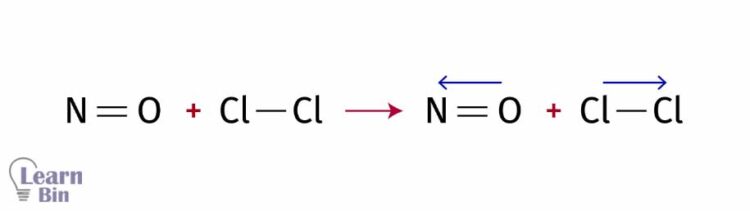
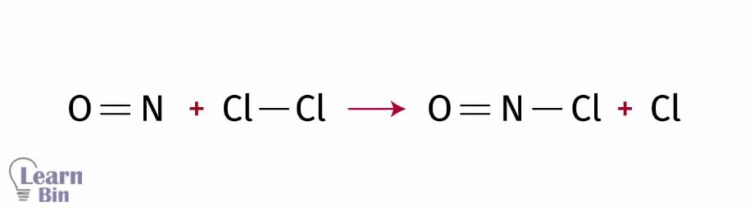
To obtain products, the Cl atom in the Cl2 and the nitrogen atom in the NO should collide. If the Oxygen atom and the Cl atom collide, they will not react and give products. Therefore, the orientation of the collision is important.
Finally, the energy of the collision must exceed the activation energy of the reaction. Activation energy is the minimum energy required to form products. To occur a chemical reaction, first, the bonds in the reactants should be broken down. To break those bonds, the reactants must contain a minimum energy.
The reactant molecules or atoms have kinetic energy. Using that kinetic energy, the bonds are broken down. If the collision does not acquire sufficient energy, the reactants will not give products. Such kind of reactions should be supplied with energy externally.
When the bonds are broken down, they absorb energy. When the bonds are formed, they release energy. If the energy required for breaking bonds is higher than the energy released when bonds are formed, the enthalpy of the reaction is positive (+ΔH). Such reactions are known as endothermic reactions.
On the other hand, if the energy required for breaking bonds is lower than the energy released when bonds are formed, the enthalpy of the reaction is negative (-ΔH). Such reactions are known as exothermic reactions. The energy difference between the product and the reactants is the enthalpy of the reaction.


Initially, the reactants have energy. When the bonds are being broken, the energy is absorbed. So, the energy increases and it reaches a maximum level. At this point, the bonds are still being broken down, and the new bonds are being formed. The species that is formed at the maximum energy point is known as the activated complex. The activated complex has the highest energy, so it is highly unstable.
Therefore, it will collapse into either products or back to reactants. When the products are formed, the bonds are formed. When the bonds are formed, they release energy. So, the energy decreases.
For a reaction to occur, the collision of the reactants must surpass the maximum energy required to form the active complex. If the collision does not have sufficient energy, the reaction medium should be supplied with energy externally.
This energy is known as the activation energy for a reaction. In other words, the activation energy is the minimum energy required to start a reaction. The activation energy is not affected by factors like temperature, pressure, and concentration.
As a summary, there are three main requirements that should be fulfilled to occur a chemical reaction.

The cover image was created using a photo by Ivan Samkov from Pexels