More results...

In the study of chemical kinetics, it is essential to understand the behavior of reactants at the molecular level. The behavior of the reactants at the molecular level is explained by the reaction mechanism. According to the reaction mechanism, the chemical reactions can be categorized into two broad categories:
An elementary reaction is a single-step process in which reactants form products directly. On the other hand, a Complex reaction involves two or more reaction steps that occur in sequence or in parallel.
Molecularity of a reaction is the minimum number of molecules, atoms, or ions required for the reaction to occur. The molecularity of the reaction is given by the sum of the stoichiometric coefficients of the balanced chemical equation. The molecularity of a reaction must always be a positive integer. It cannot be a negative number, zero, a fractional number, or an imaginary number.
When the molecularity of a reaction is 1, 2, or 3, the reaction is known as unimolecular, bimolecular, or termolecular, respectively. But the molecularity can be more than three. As an example, the molecularity of the following reaction is 23.

Unimolecular reactions are usually decomposition reactions or rearrangement reactions. In this reaction, a single molecule decomposes into products or rearranges its atoms to another isomer.
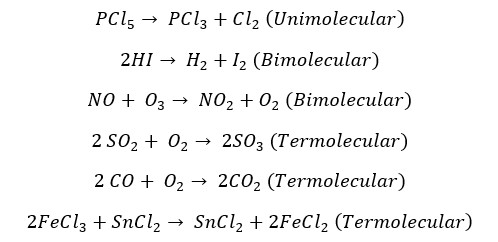
According to the collision theory, reactants collide with each other to obtain products. Elementary reactions, or the single-step reactions, are the reactions that result in products directly in a single molecular event. Elementary reactions usually are unimolecular, bimolecular, or termolecular. But termolecular elementary reactions are quite rare. Here are some examples of elementary reactions.
Practically, the elementary reactions with the molecularity higher than 3 are impossible. In an elementary reaction, the molecules must collide simultaneously in a correct orientation and with sufficient energy to give products. This is practically possible when one, two, or three molecules are involved in the reaction.
But when more than three molecules are involved in the reaction, it is hard to produce a product in a single step. Such reactions occur in multi-step processes. Although all the elementary reactions are unimolecular, bimolecular, or termolecular, it cannot be concluded that all the unimolecular, bimolecular, and termolecular reactions are elementary. There are some unimolecular reactions that are multi-step reactions.
In an elementary reaction, the order of the reaction with respect to each reactant is given by the stoichiometric ratio of each reactant. Consider the following bimolecular elementary reaction.
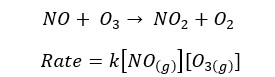
In the above reaction, the reaction order with respect to NO is 1, and the reaction order with respect to O3 is also 1. And the overall order of the reaction is 2.
When considering the molecularity of a reaction, it is possible to occur unimolecularly and bimolecularly in a single-step process. Rarely, there are termolecular elementary reactions. But, when the molecularity increases more than 3, it is practically impossible to collide all the reactants at once and obtain the products.
Therefore, such reactions occur in several individual steps. Although all the elementary reactions are unimolecular, bimolecular, or termolecular, not all the unimolecular, bimolecular, and termolecular reactions are elementary. There are some unimolecular reactions that occur in multiple steps. As an example, the decomposition of ozone gas takes place in two steps.
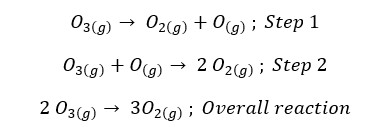
A multi-step reaction can be considered as a set of elementary reactions. When the reaction proceeds, some species are formed, and in later steps, those species are consumed. Those species are known as intermediates. The intermediate is not included in the overall balanced chemical reaction.
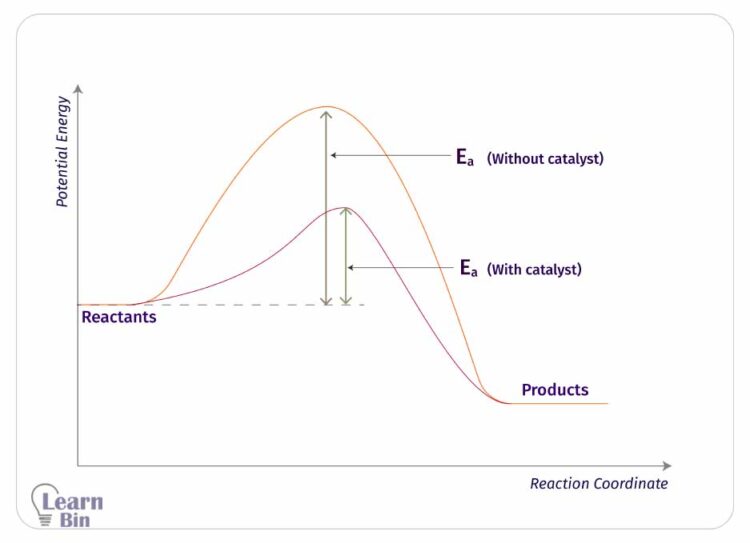
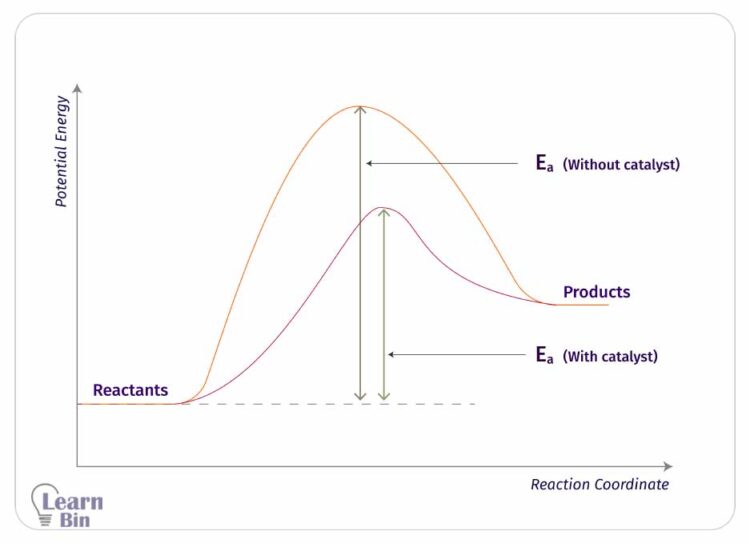
The rate of the reaction can be increased using a catalyst. Catalysts will introduce another path for the reaction to occur that has a lower activation energy. Catalysts are used in the reaction and regenerated at the end. It is also not included in the overall reaction.
Let’s consider the following complex reaction of decomposition of H2O2. This reaction can be catalyzed by introducing iodide ion (I-) to the reaction medium. And the reaction occurs in a two-step process.
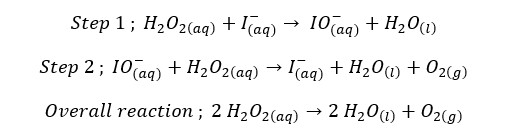
In the above reaction, it can be observed that the IO- ions have been formed in the first step and have been consumed in the second step. That means, IO- is the intermediate of the reaction. On the other hand, the I- ions have been consumed in the first step, and they have been regenerated in the second step. Therefore, the I- is the catalyst of this reaction.
As shown in the above example, in complex reactions ( multistep reactions), an intermediate is formed, and usually, catalysts are formed. However, the catalysts and the intermediate are not involved in the overall reaction. Therefore, the concentrations of the catalyst and the intermediate are not involved in the rate law.
Usually, in multi-step reactions, there are some steps that occur rapidly and some other steps that occur very slowly. The overall rate of the reaction depends on the rate of the slowest process. Therefore, the slowest step in a multi-step reaction can be considered as the “rate-determining step (RDS)”. Let’s take an example where reactant A turns into product B. And the reaction occurs through two steps as follows.
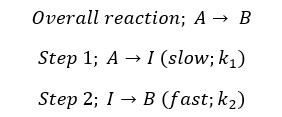
Where k1 and k2 are the rate constants of steps 1 and 2, respectively, since the first step is slower than step 2, k2 must be greater than 1 (k2 >> k1). In this reaction, I is the intermediate. The intermediate “I” is formed slowly from the reactant “A”.
As soon as "I" is formed, it decays into the product "B". Therefore, the overall rate of the reaction is affected by step 1. The rate law of the overall reaction must be the rate law of the slowest step or the rate-determining step (RDS)
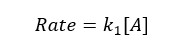
Where,
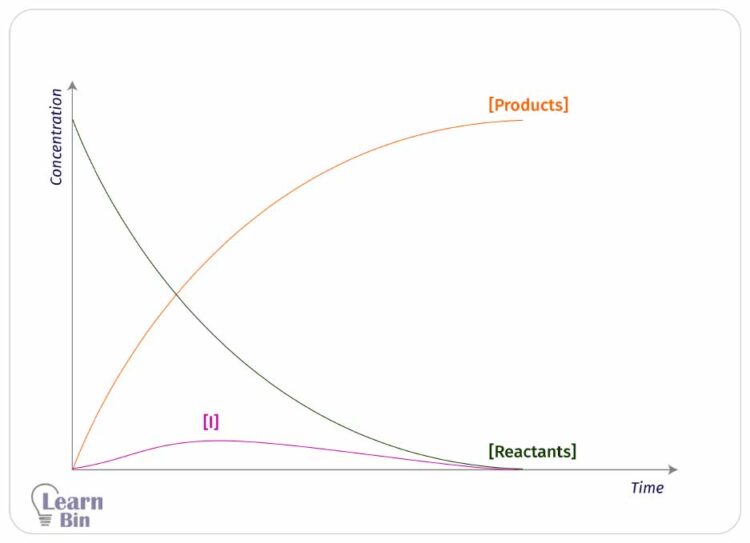
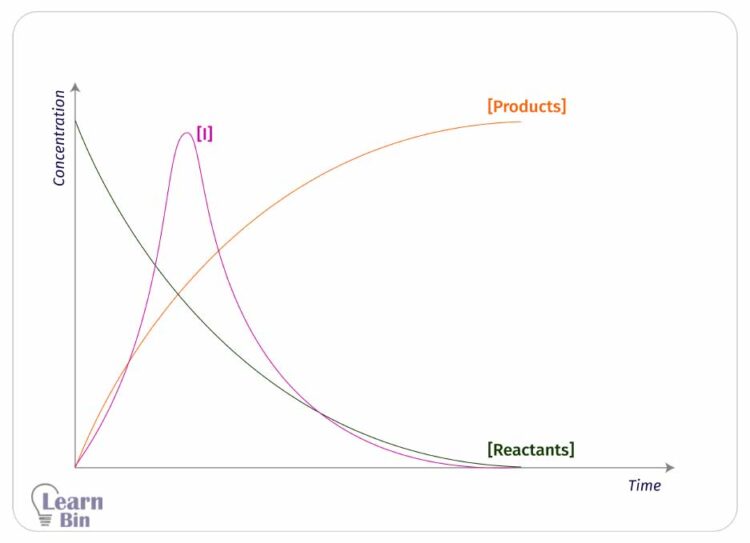
When the overall reaction is considered, the reactant concentration is decreasing with time, and the product concentration is increasing. If the first step is slow, it takes much time to form the intermediate (I). As soon as the intermediate is formed, it will be converted into products. Therefore, in such instances, the concentration of the intermediate is very low or negligible.
But if the first step is fast and the second step is slow, it will form the intermediate (I) rapidly. Since the second step is slow, the intermediate is accumulated in the reaction medium. In such instances, the concentration of the intermediate is increased up to a maximum level, and it is decreased where the reaction proceeds.
Let’s consider a real example of the reaction between Nitrogen dioxide and Carbon monoxide. Experimentally, it has been found that this reaction is a complex reaction that occurs through two elementary steps. Also, the first step is the rate-determining step.
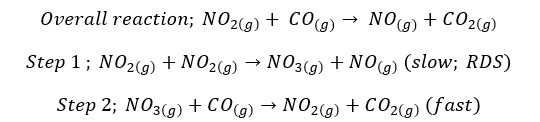
Since the first step is the rate-determining step, the overall rate law expression for the reaction would be the rate law expression of step 1. Each step of a complex reaction can be considered as an elementary reaction. Therefore, the order of the reaction is given by the stoichiometric ratios of the reactants in step 1. If the rate constant for step 1 is k, the rate law expression for the above reaction can be written as follows.
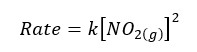
From the above rate law expression, it can be seen that the reaction is 2nd order with respect to the reactant NO2 and zero order with respect to CO. Therefore, CO does not appear in the rate law. It means the change in the concentration of the CO does not affect the overall rate of the reaction.
Note that the rate law is determined by the experimental data. According to the experimental rate law, a reaction mechanism is introduced.
To predict a mechanism for a reaction, first, the rate law is determined by experimental methods. Let’s consider a hypothetical reaction between A and B. And it has been found that the order of the reaction with respect to the reactant A is 1, and with respect to the reactant B is zero. Therefore, the overall reaction and the rate law can be written as follows.
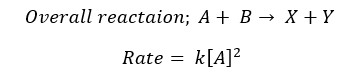
Here are some mechanisms that can be predicted for the above reaction.
Mechanism 01

Mechanism 02
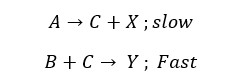
Mechanism 03
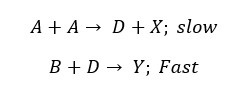
If we consider mechanism 1, the order of the reaction with respect to both A and B should be 1. Because in elementary reactions, the order of the reaction is equal to the stoichiometric ratios of the reactants. But it does not match the experimental rate law. Therefore, the first mechanism is not correct, and the reaction is not elementary.
In the second mechanism, there is a complex reaction. The overall rate law would be the rate law of the slowest step. Hence, the reaction must be zero order with respect to B and first order with respect to A. This rate law does not match the experimental rate law.
But in the third mechanism, if we take the rate law of the slowest step, the reaction is second order with respect to A and zero order with respect to B. Therefore, the third mechanism is the acceptable mechanism.
In some complex reactions, the reaction mechanism involves a pre-equilibrium. Let’s assume that the following hypothetical reaction has a pre-equilibrium step.
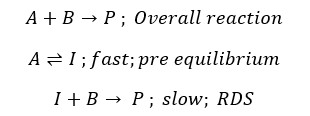
In the above example, first, the reactant A is in an equilibrium with the intermediate I. In an equilibrium, products are formed and decay back to their reactants at the same rate. Thus, the intermediate I is formed and decays into A at a higher rate. The intermediate “I” will react with reactant B to give the final product P. Since the overall rate of the reaction must be the rate of the slowest step, the rate law for the above reaction can be given as follows.

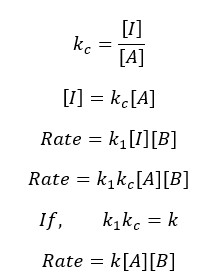
In this rate law, the concentration of the intermediate is included. But the concentrations of intermediates or catalysts cannot be included in the overall rate law. The term [I] should be substituted. The equilibrium constant for concentration for the first step can be written as follows.
In chemical reactions, it is a necessary requirement to surpass the activation energy barrier for the reaction to occur. If the collision of the reactants does not have sufficient energy to surpass the activation energy, the reactant molecules will bounce back from each other.
In chemical reactions, new bonds are formed. Also, some existing bonds are broken down. In this process, the nuclei of reactant molecules attract each other's electron clouds. When reactant molecules get closer, the atomic orbitals will overlap to form new bonds, and the electron densities shift. In this situation, new bonds are being formed, and the existing bonds are being broken down.
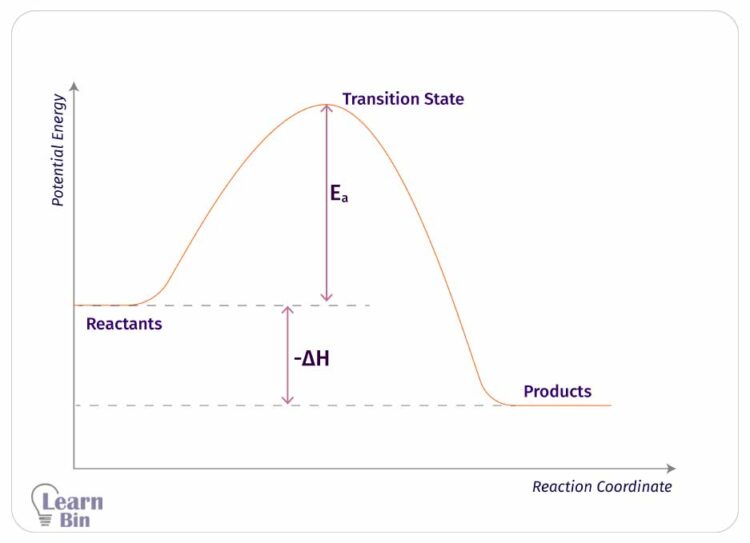
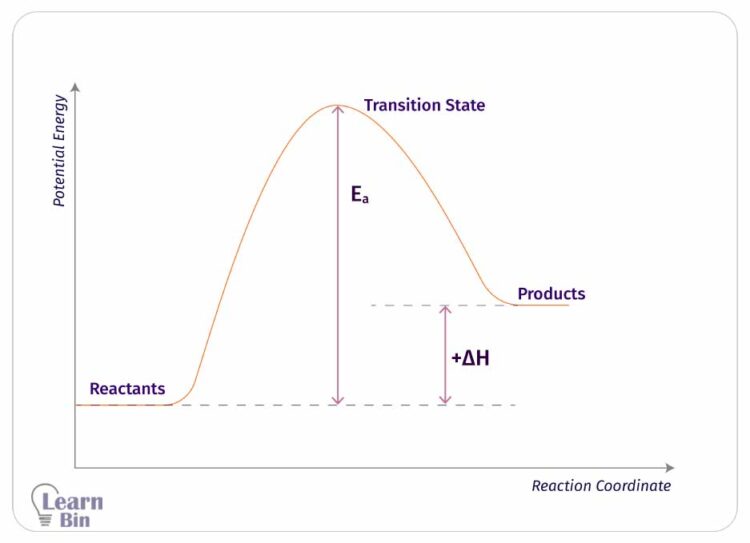
This is a very unstable species, and it is the highest energy position of the reaction. This position is known as the transition state, and the species obtained at the transition state is known as the activated complex. The activation energy is required to obtain the activated complex.
An active complex is neither a reactant nor a product. It can be converted into reactants or products. Both products and the reactants have less energy than the active complex. When comparing the energy of the reactants and the products, if the reactants have higher energy, the reaction is exothermic, and if the products have higher energy, the reaction is endothermic.
If the above reaction is introduced with a catalyst, the reaction will occur through an alternative path where the activation energy is low.
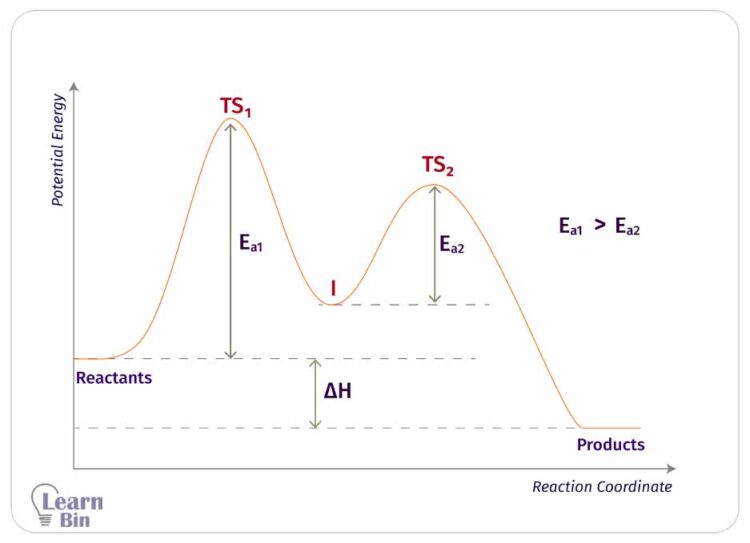
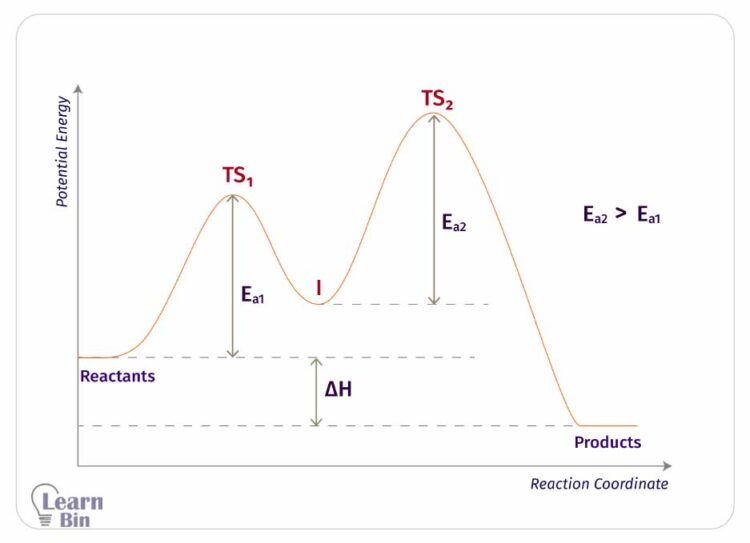
In a complex reaction, there are more steps than one. Also, intermediates are formed. An intermediate is neither a reactant nor a product. Also, it is not an activated complex. The intermediate is less stable than the reactants or products, and it is more stable than the activated complex.
In other words, the intermediate has higher energy than both reactants and the products. But it has lower energy than the activated complex. In complex reactions, the slowest step has the maximum activated complex. The energy profile of complex reactions with two steps is shown in Figures 7 and 8. Here, the reaction undergoes two transition states (TS1 and TS2)

The cover image was created using an image by Ivan Samkov from Pexels