More results...
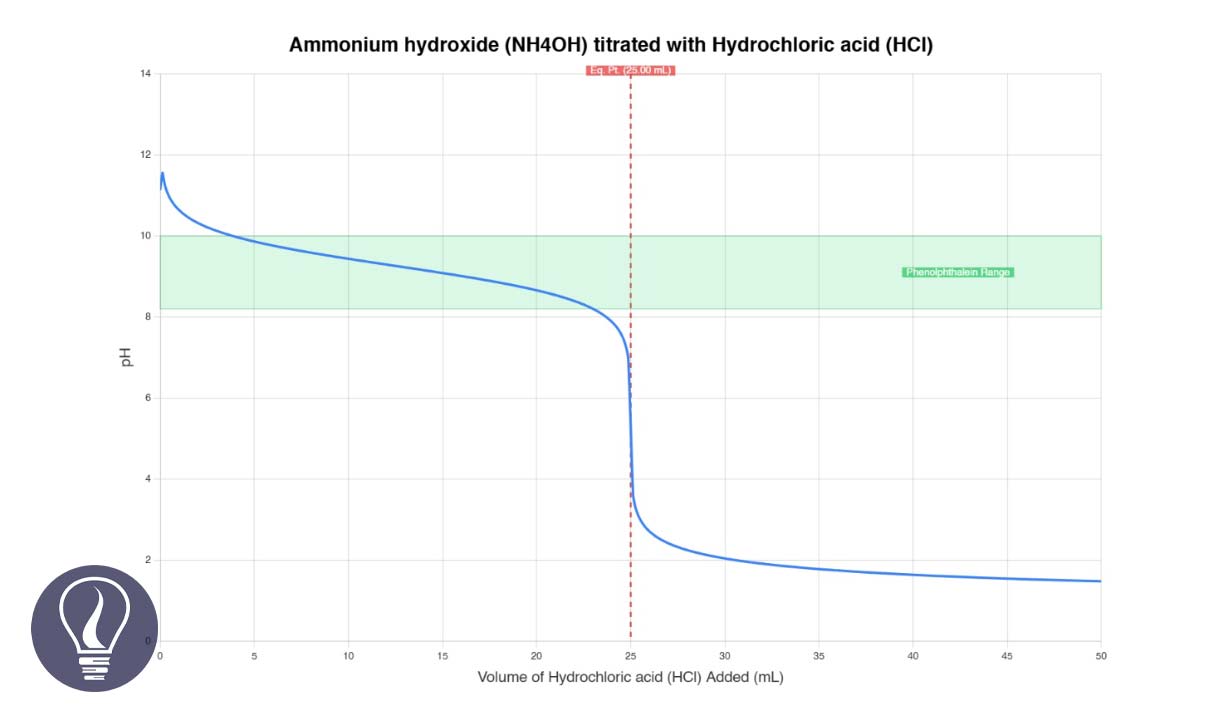

A strong acid-weak base titration is a common analytical technique used to determine the concentration of an unknown solution by measuring its reaction with a known titrant. In this process, a strong acid, which dissociates completely in water, reacts with a weak base that only partially ionizes. As the titration progresses, the weak base is gradually neutralized, forming a salt of the weak base in solution.
Because the conjugate acid of this salt can donate protons to the medium, the solution at the equivalence point is acidic. Understanding the behavior of such titrations is crucial in analytical chemistry, as it reveals important information about acid-base equilibria, buffer formation, and the pH changes throughout the titration process.
During a strong acid-weak base titration, the titration curve typically shows a gradual decrease in pH as the acid is added. Initially, the solution has a basic pH due to the weak base. As titration proceeds, a buffer region appears where the weak base and its conjugate acid coexist, resisting drastic pH changes. Near the equivalence point, the pH drops sharply, and because the resulting solution contains the conjugate acid of the weak base, the equivalence point lies below pH 7. After this point, the addition of excess strong acid causes the pH to decrease further, resulting in a steep acidic region on the curve.
In strong acid-weak base titrations, the strong acid will completely dissociate in the aqueous medium. But the weak base will partially dissociate and result in OH- ions in the medium. An acid-base reaction results in the respective salt and H2O. The salt that is formed by a strong acid-weak base titration is acidic.
Let’s take an instance where an amount of 25 cm³ of 0.1 mol dm-3 NH4OH solution is titrated with 0.1 mol dm-3 HCl solution. NH4OH solution is taken to the titration flask, and the HCl is added to the burette. The titration is carried out at 25 °C. At 25 °C, the dissociation constant of NH4OH is 1.8 × 10⁻⁵ mol dm-3. In this titration, the following reaction occurs.

Let’s find out the change in pH of the solution with respect to the volume added of HCl. Then the pH titration curve is plotted between the pH vs the volume added of HCl.
Q 01: What is the initial pH of the solution?
Initially, there is only a dilute solution of NH4OH in the titration flask. Since NH4OH is a weak base, it will dissociate partially into NH4+ ions and OH- ions. The OH- ions can be calculated using the dissociation constant of the NH4OH. If the dissociation amount of the NH4OH is x, the concentration of each component at the equilibrium can be calculated as follows.

| NH4OH(aq) | NH4+(aq) | OH-(aq) | |
| Initial concentration (mol dm-3) | 0.1 | - | - |
| Concentration at the equilibrium (mol dm-3) | 0.1 - x | x | x |
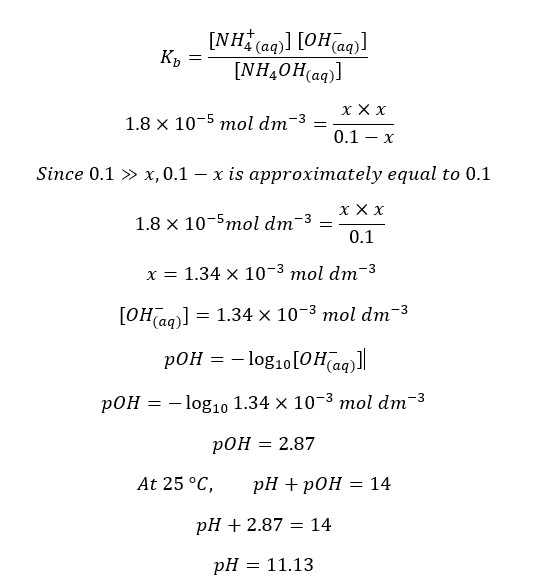
In this calculation, the OH- ion concentration comes from the dissociation of water, has been neglected.
Q 02: Find the pH of the solution when 5 cm³ of HCl is added. Kb of the ammonium hydroxide is 1.8 × 10⁻⁵ mol dm-3.
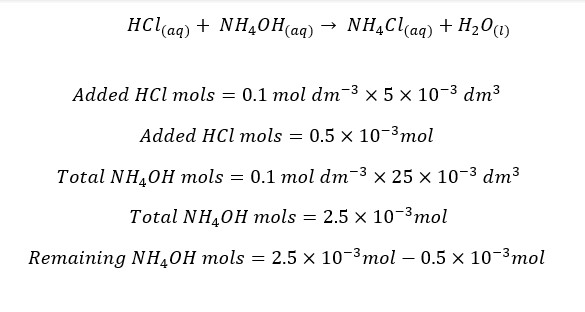
According to the following equation, the stoichiometric ratio between HCl and NH4OH is 1:1. Therefore, it forms an equal number of NH4Cl mols as the HCl. Since there is a weak base and its conjugate acid in the system, this solution can act as a buffer solution.
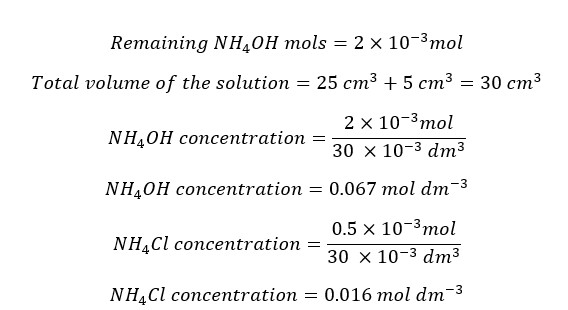
pOH of a buffer solution is given by the Henderson-Hasselbalch equation.
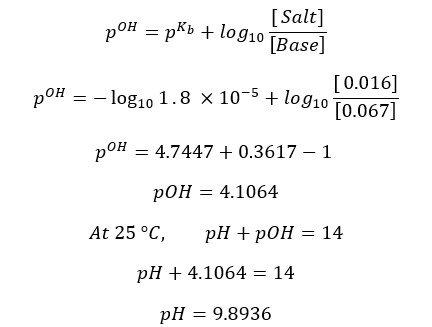
In this calculation, the OH- ion concentration comes from the dissociation of water, has been neglected.
Q 03: Find the pH of the solution when 10 cm³ of HCl is added. Kb of the ammonium hydroxide is 1.8 × 10⁻⁵ mol dm-3.
According to the following equation, the stoichiometric ratio between HCl and NH4OH is 1:1. Therefore, it forms an equal number of NH4Cl mols as the HCl. Since there is a weak base and its conjugate acid in the system, this solution can act as a buffer solution.
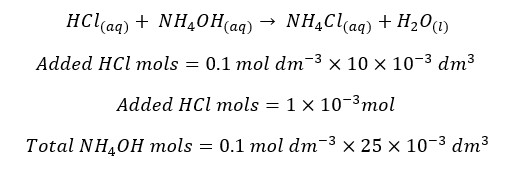
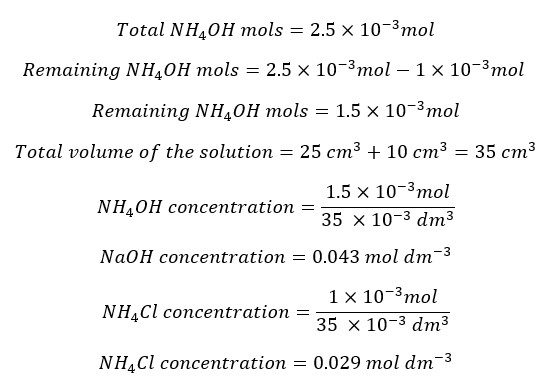
pOH of a buffer solution is given by the Henderson-Hasselbalch equation.
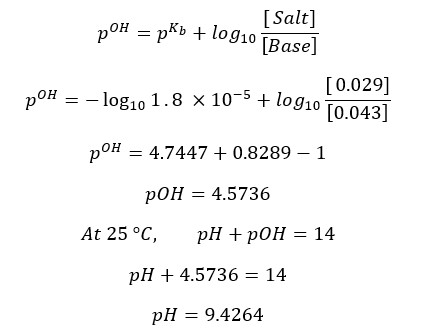
In this calculation, the OH- ion concentration comes from the dissociation of water, has been neglected.
Q 04: Find the pH of the solution when 20 cm³ of HCl is added to the solution.
Since the stoichiometric ratio between NH4OH and HCl is 1:1, it forms an equal number of NH4Cl mols as the HCl. Since there is a weak base and its conjugate acid in the system, this solution can act as a buffer solution.
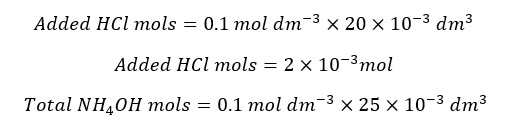
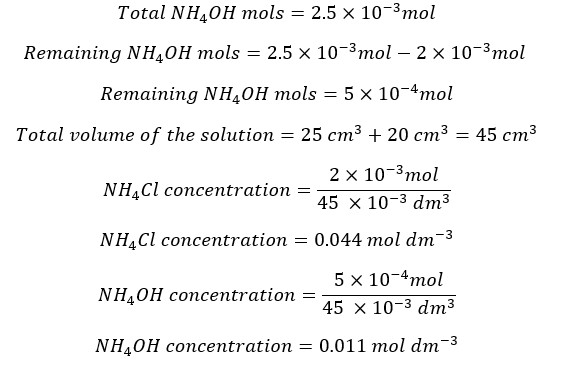
pOH of a buffer solution is given by the Henderson-Hasselbalch equation.
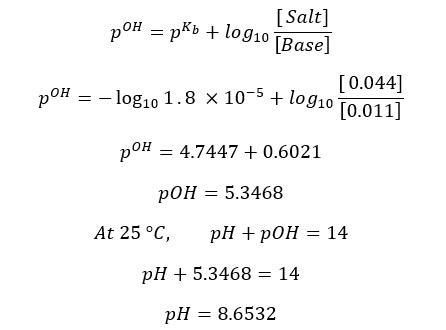
In this calculation, the OH- ion concentration comes from the dissociation of water, has been neglected.
Q 05: Find the pH of the solution when 24.9 cm³ of HCl is added to the solution.
Since the NaOH and HCl are equal in concentration and the stoichiometric ratio between HCl and NH4OH is 1:1, it forms an equal number of NH4Cl mols as the HCl. Since there is a weak base and its conjugate acid in the system, this solution can act as a buffer solution.
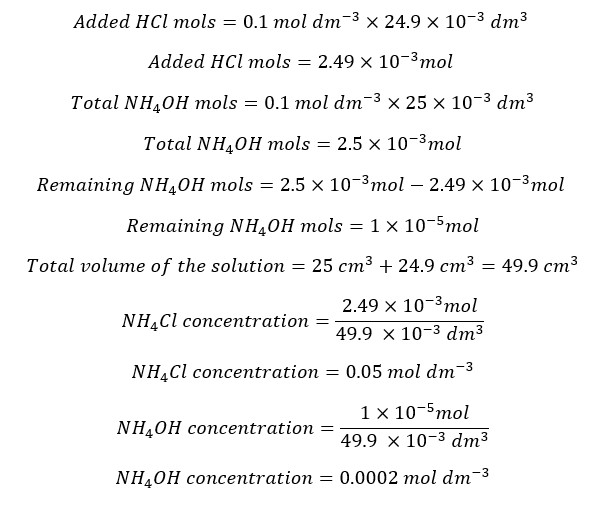
pOH of a buffer solution is given by the Henderson-Hasselbalch equation.
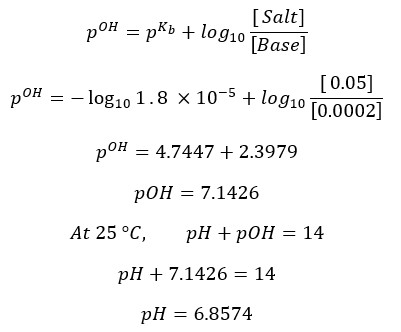
In this calculation, the OH- ion concentration comes from the dissociation of water, has been neglected.
Q 06: Find the pH of the solution when 25 cm³ of HCl is added to the solution
Since the NH4OH and HCl are equal in concentration, at this point all the NH4OH mol in the solution will completely react with the HCl to form NH4Cl and H2O. Therefore, this is the equivalent point of the reaction. At this point, there is no excess acid or base. The pH of the solution is given by the dissociation of the conjugate acid of the weak base.
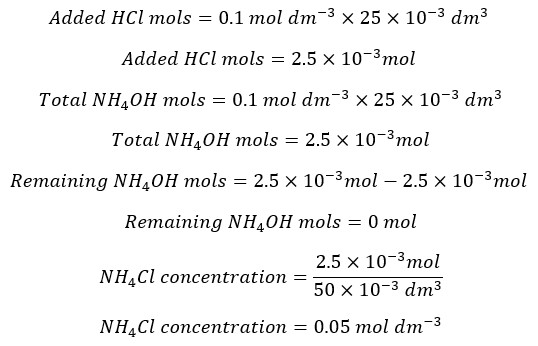
In this medium, the salt NH4Cl will dissociate into NH4+ ions and Cl- ions. These NH4+ ions can act as a conjugate acid. In other words, NH4+ reacts with water and results in H+ ions in the water while regenerating the NH4OH base.
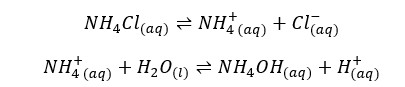
In the second reaction it shows that it liberates H+ ions to the solution. Therefore, NH4+ ions can act as an acid. The dissociation constant of this conjugated acid can be calculated as follows. Where the Kb of the NH4OH is 1.8 × 10⁻⁵ mol dm-3. And the dissociation constant of water is 1 × 10-14 mol2 dm-6 at 25 °C.
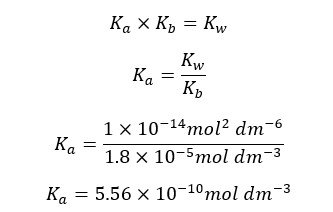
H+ ions in the solution can be calculated using the Ka value of the conjugate base. If the concentration of the H+ ions in the solution is x,
| NH4+(aq) | NH4OH(aq) | H+(aq) | |
| Initial concentration (mol dm-3) | 0.05 | - | - |
| Concentration at the equilibrium (mol dm-3) | 0.05 - x | x | x |
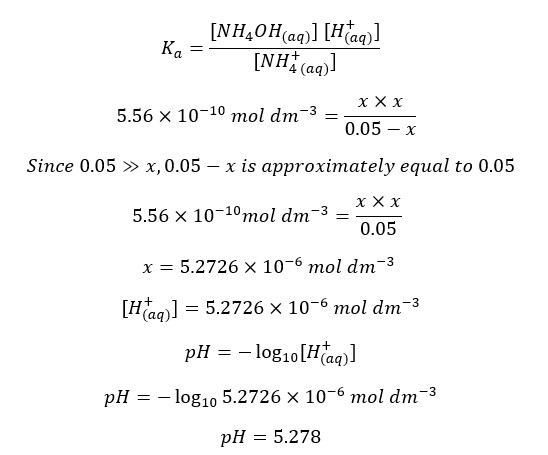
At the equivalent point, the pH of the solution is 5.278. That means the solution is acidic. In strong acid-weak base titrations, an acidic equivalent point is obtained.
Q 07: Find the pH of the solution when 25.1 cm³ of HCl is added to the solution
After the equivalent point, the base has been completely reacted with the acid. If 25.1 cm³ of HCl is added to the solution, there is are excess of acid in the solution. In this system, there are two types of acids that result in H+ ions in the solution. One is HCl, and the other one is the conjugate acid of the NH4OH, which is NH4+ ions.
However, the H+ ions given by the NH4+ ions are negligible due to the common ion effect. The H+ ions given by the HCl decrease the reaction between NH4+ ions and the water according to the Le Chatelier principle. Therefore, the total H+ ions in the system are approximately equal to the H+ ions given by the dissociation of HCl.
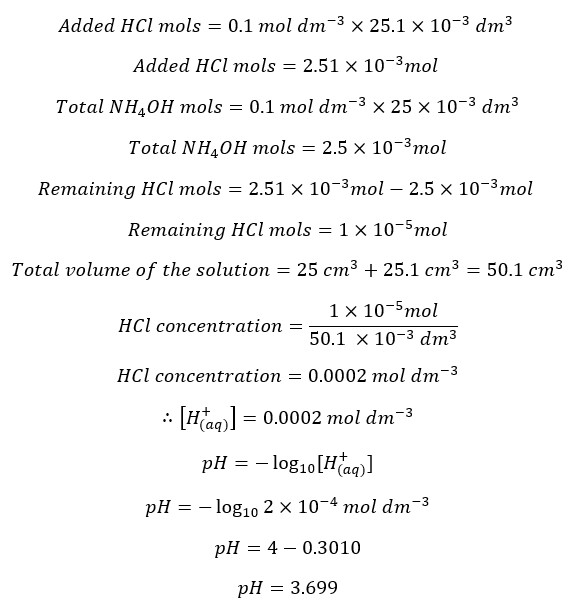
After the equivalent point, even a small addition of the acid makes a significant change in pH. At the equivalent point, the pH was 5.1273. After the addition of 0.1 cm³ of HCl, the pH of the solution has dramatically changed to pH = 3.7.
Q 08: Find the pH of the solution when 30 cm³ of HCl is added to the solution
At this point, too, the H+ ions given by the NH4+ ions are negligible due to the common ion effect. Therefore, the total H+ ions are approximately equal to the H+ ions given by the dissociation of the HCl.
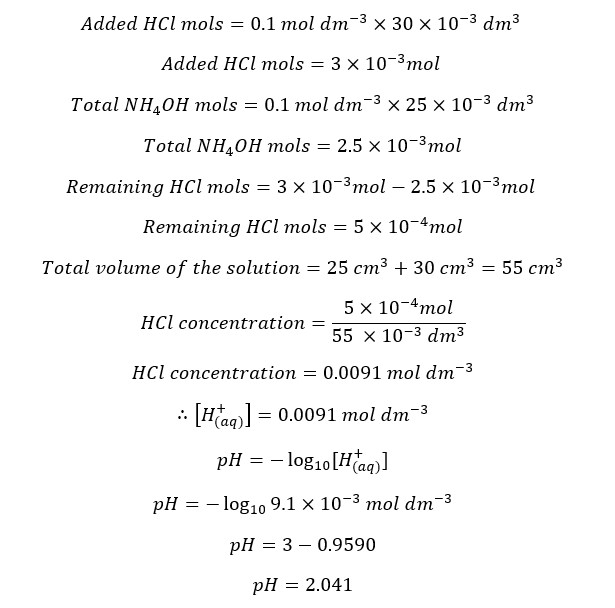
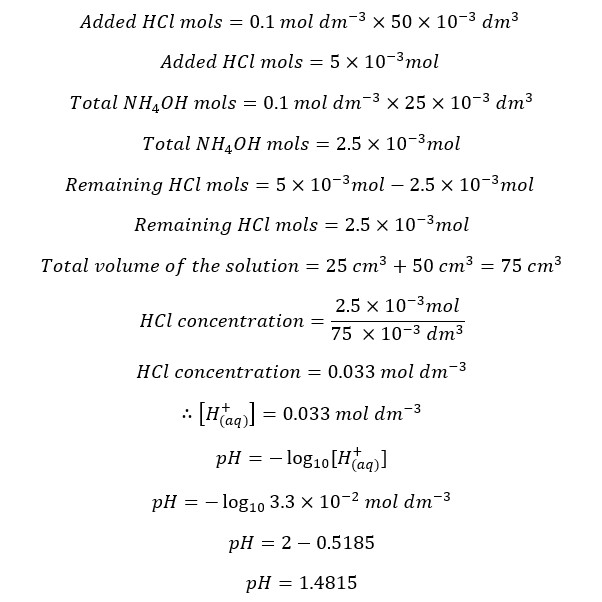
Q 09: Find the pH of the solution when 50 cm³ of HCl is added to the solution
At this point, too, the H+ ions given by the NH4+ ions are negligible due to the common ion effect. Therefore, the total H+ ions are approximately equal to the H+ ions given by the dissociation of the HCl.
Let’s tabulate the added HCl volume and the obtained pH values in the above calculations.
| HCl volume (cm3) | pH |
| 0 | 11.13 |
| 5.0 | 9.89 |
| 10.0 | 9.43 |
| 20.0 | 8.65 |
| 24.9 | 6.86 |
| 25.0 | 5.28 |
| 25.1 | 3.70 |
| 30.0 | 2.04 |
| 50.0 | 1.48 |
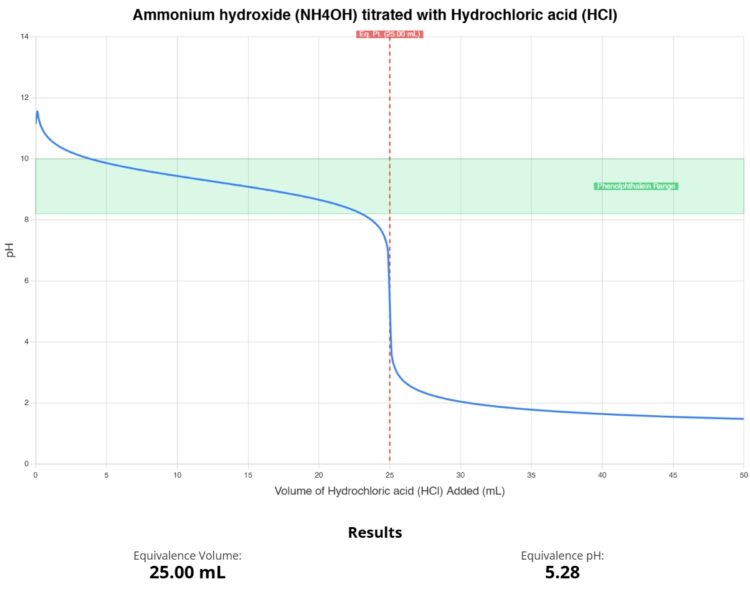
Use the Interactive Titration Curve Simulator by Learnbin Lab to create pH titration curves

Harris, D. C.; Lucy, C. A. Quantitative Chemical Analysis, 9th ed.; W. H. Freeman & Company: New York, 2016.
The cover image and Figure 01 were created using an Interactive Titration Curve Simulator by Learnbin Lab