More results...
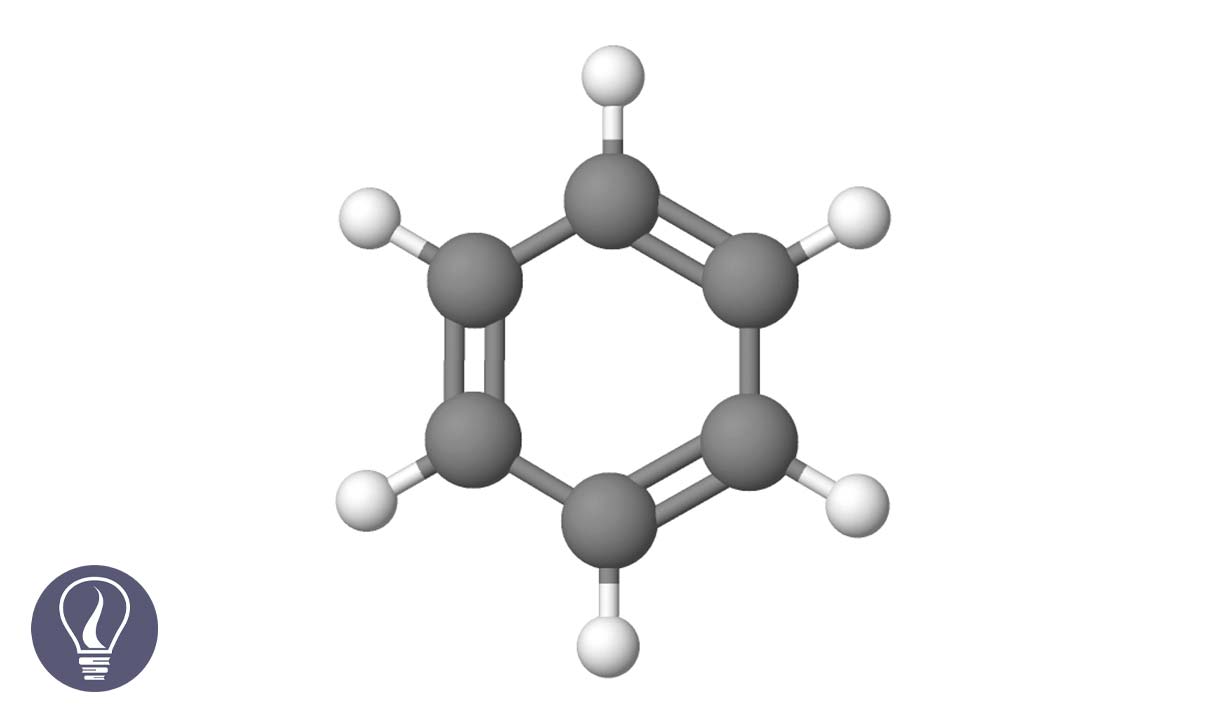

Benzene is a simple aromatic hydrocarbon that consists of six carbon atoms and six hydrogen atoms (C6H6). When compared to alkane, alkene, and alkyne with six carbon atoms, the unsaturation of benzene is much higher. According to the theory, there must be double bonds and/or triple bonds in the benzene structure.
| Compound | C : H ratio |
| Hexane | 6:14 |
| Hexene | 6:12 |
| Hexyne | 6:10 |
| Benzene | 6:6 |
In 1865, a German chemist, Friedrich August Kekulé, introduced a structure for benzene according to the hydrogenation data of benzene. He found that benzene reacts with H2 in a 1:3 ratio. One benzene mol reacts with 3 moles of H2.
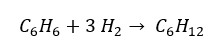
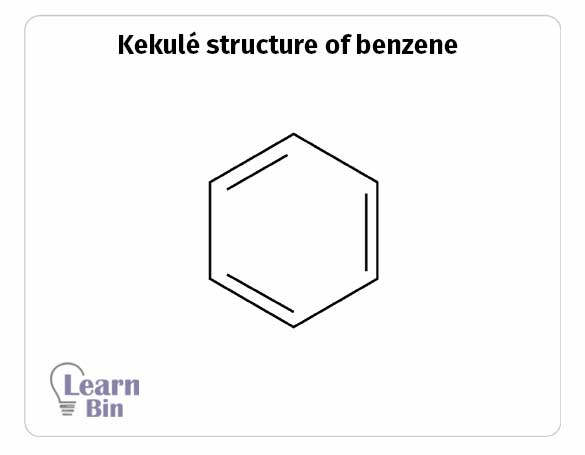
To react with 3 mols of H2, there must be three double bonds. According to the above data, he introduced a cyclic structure with three C=C double bonds for benzene. It says that he had a dream of a snake that was biting its own tail. That dream was the one that inspired him to discover this structure.
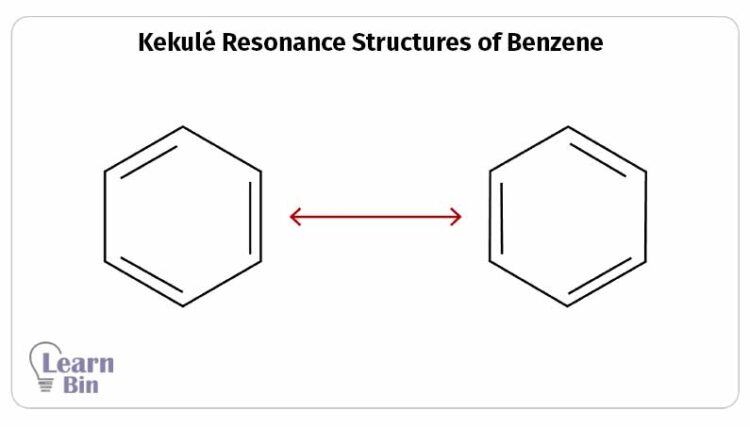
Also, it has been suggested that benzene has the following two resonance structures.
According to the Kekulé structure, there are three double bonds and three single bonds in the benzene ring. So, there should be two types of bonds, and the bond lengths should not be equal to each other. The bond length of the C=C double bond is 1.34 A°. The bond length of the C-C single bond is 1.54 A°.
But in benzene, all the bonds are equal in length, and the C-C bond length in benzene is 1.39 A°. That value is higher than a C=C double bond and lower than a C-C single bond. This explains that benzene does not consist of two types of bonds. Also, all the C-C bonds are neither pi bonds nor sigma bonds. It must be in between somewhere.
The second evidence that the Kekulé structure is not true is the reaction with Br2 or the reaction with basic KMnO4. The compounds with double or triple bonds could react with Br2 and basic KMnO4. In the reaction with Br2, it can be observed that the red color of the Br2 turns colorless.
In the reaction with basic KMnO4, the purple color of the KMnO4 turns into a brown color (MnO2). But benzene does not undergo each of the reactions. Therefore, benzene may not have any double bonds.
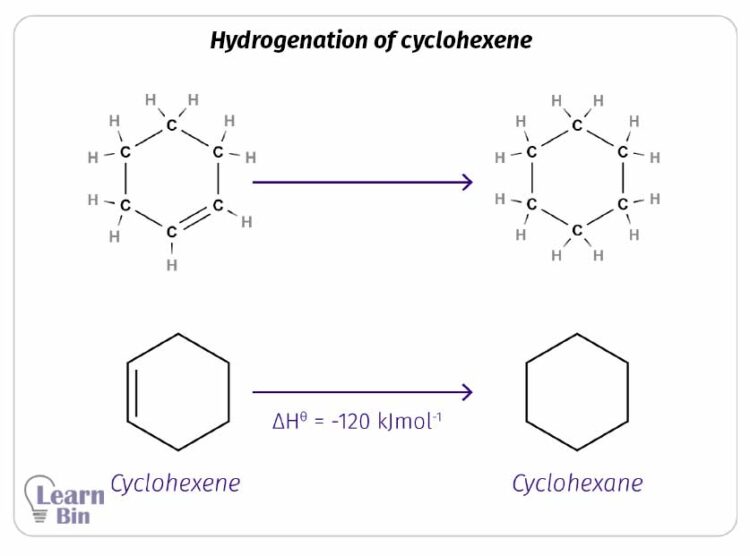
Also, the hydrogenation enthalpy of the Kekule structure does not match the real benzene. Let’s consider cyclohexene (C6H10), which is a cyclic alkene with one double bond. When it is hydrogenated, it forms cyclohexane (C6H12), which is a cyclic alkane. The standard enthalpy of hydrogenation per 1 mol of cyclohexene (1 mol of double bonds) is -120 kJ/mol.
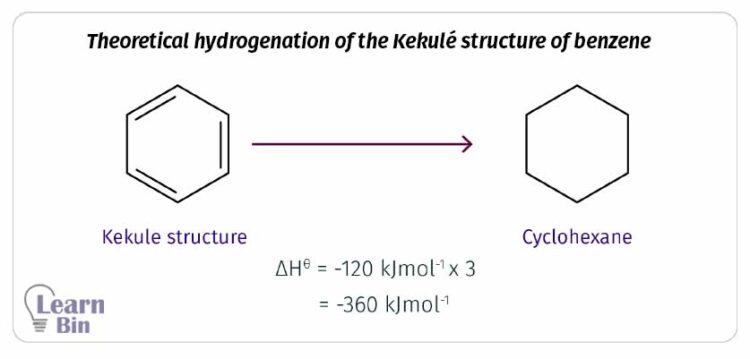
In the Kekulé structure, there are three double bonds. Theoretically, it needs 3 mol of H2 to hydrogenate the Kekulé structure of benzene to form cyclohexane. So, the standard enthalpy of hydrogenation must be three times the standard enthalpy of hydrogenation of cyclohexene. So, it must be -360 kJ/mol.
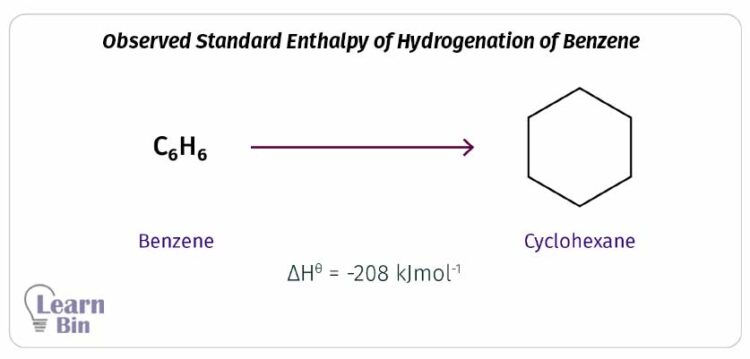
But the standard enthalpy change of hydrogenation of benzene (C6H6) is -208 kJ/mol. After hydrogenation, it forms the same compound as cyclohexane. The standard enthalpy change of the hydrogenation of benzene is less than the Kekulé structure.
That means the real benzene is more stable than the Kekulé structure. The energy difference between the Kekule structure and the real benzene is known as “Resonance energy”. This can be explained in an energy diagram as follows.
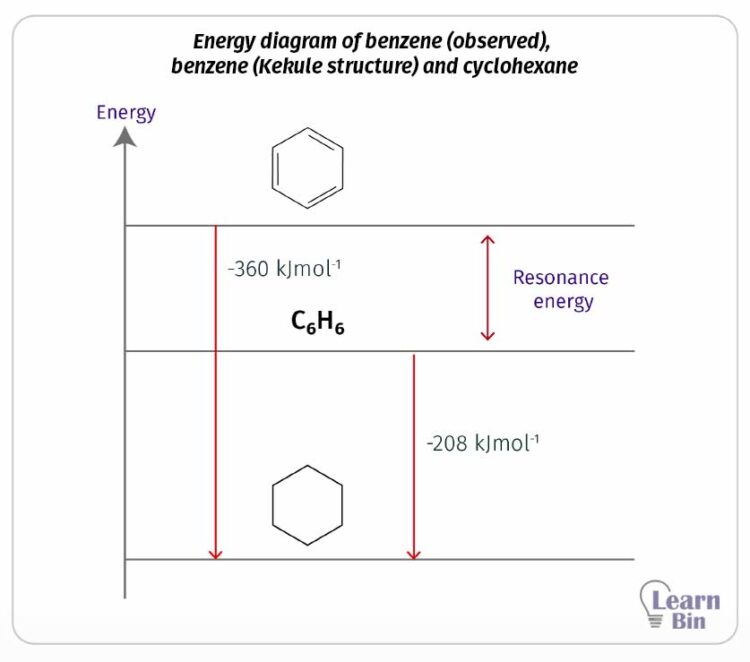
According to the above evidence, the Kekule structure is not compatible with the real benzene. The hybridization of all the carbon atoms in the benzene is sp2. It forms three sp2 hybridized orbitals and one unhybridized 2p orbital with a lone electron.
The three sp2 hybridized orbitals exist in the trigonal planar geometry. The six carbon atoms are arranged in a circle to form the six-membered ring of benzene. Two out of three sp2 orbitals are used to form C-C sigma bonds by the linear overlapping of the sp2-sp2 hybridized orbitals. The remaining sp2 hybridized orbital forms a sigma bond with hydrogen from the linear overlapping of the sp2-1s orbital of the hydrogen.
The unhybridized 2p orbital exists perpendicular to the sp2 orbital plane. There are six unhybridized 2p orbitals with a lone electron in the benzene ring. All these 2p orbitals overlap each other and form a pi-electron cloud.
They do not form localized pi bonds. Since all the 2p orbitals have overlapped, the electrons could move through the benzene ring. So, it is called a “Delocalized pi electron cloud”.
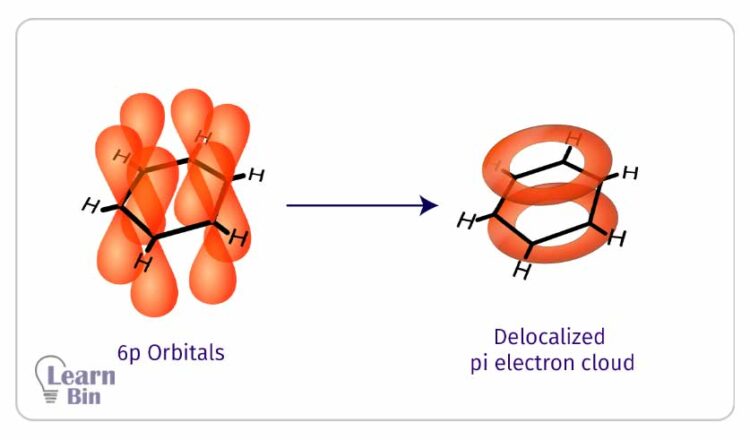
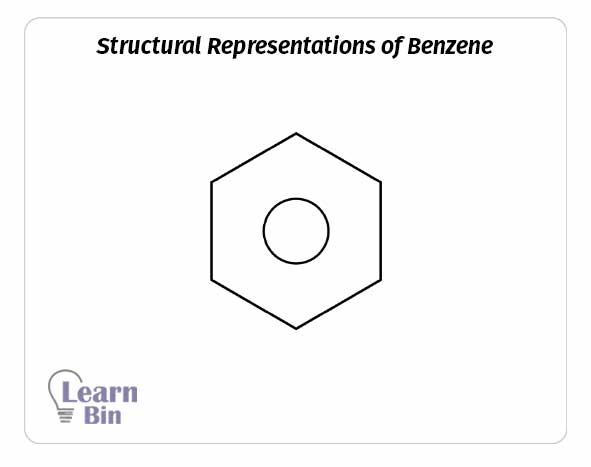
The structure of the six-membered ring in benzene is planar. The pi-electron cloud exists above and below the benzene plane. The compounds with such a delocalized pi-electron cloud are called aromatic compounds. The pi-electron cloud in the aromatic compounds is indicated in a circle inside a hexagon. But when explaining the reaction mechanisms, it uses the Kekulé structure.
Benzene is a colorless, highly flammable liquid at room temperature. Since benzene is a non-polar compound, it is not dissolved in polar solvents like water. Benzene can be dissolved in non-polar solvents like ether, carbon tetrachloride (CCl4), etc. Also, benzene is used as an organic solvent itself.
| Property | |
| Boiling point | 80.1 °C |
| Melting point | 5.5 °C |
| Density | 0.87 g/cm3 |
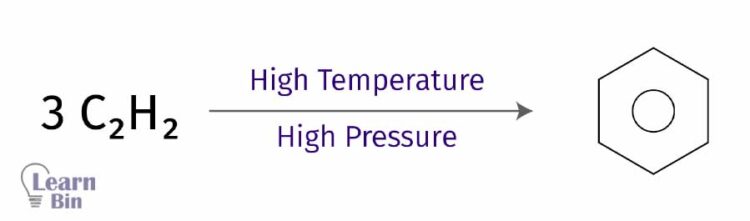
Ethyne C2H2 (acetylene) is heated up to a high temperature at high pressure in a red-hot glass tube to get benzene.
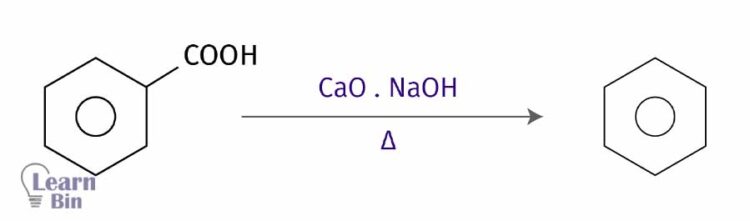
Benzoic acid is heated with soda lime, which is a mixture of CaO and NaOH, to obtain benzene. In this reaction, the -COOH group is replaced by a Hydrogen atom and obtains benzene.
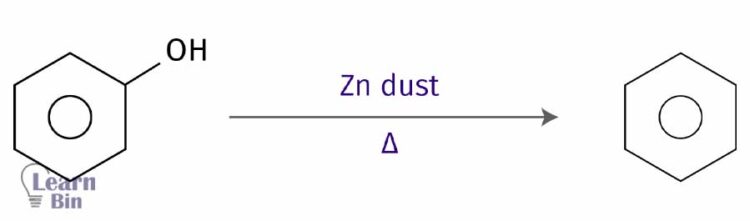
Phenol is heated with zinc dust to obtain benzene.
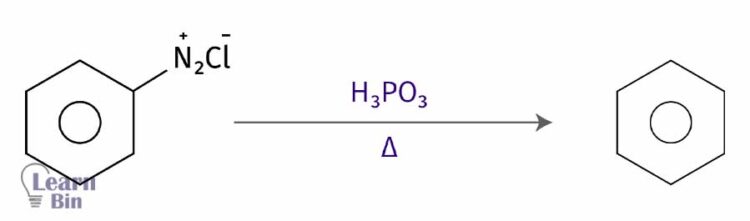
The aryl diazonium salt is heated with phosphoric(III) acid (H3PO3) to obtain benzene.
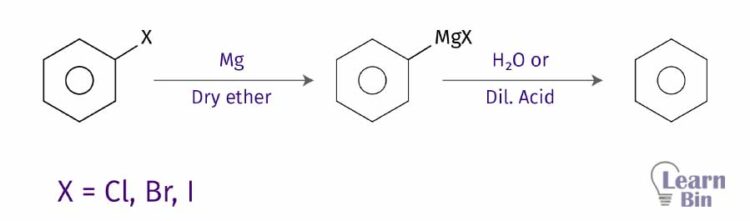
Aryl halides can be treated with Magnesium metal in the medium of dry ether to obtain the Grignard reagent. When this Grignard reagent is treated with water or a dilute acid, it results in benzene.

National Center for Biotechnology Information - Benzene
The cover image was created using the molecular editor from Molview.org
Figure 07: Contains an image by Vladsinger, licensed under CC BY-SA 3.0, via Wikimedia Commons