More results...

Alkyl halides are organic compounds with one or more halogens attached to an alkyl group. Usually, halogens are highly electronegative atoms. Therefore, the C-X bond is a polar bond. (X = F, Cl, Br, I). Carbon gets a δ+ charge, and the halogen gets a δ- charge.
The reactions of alkyl halides are fundamental in organic chemistry because they provide versatile pathways for the synthesis of a wide range of compounds. These reactions are primarily governed by the polarity of the carbon–halogen bond and the relative reactivity of different halogens (I > Br > Cl > F).
Depending on the reaction conditions and the structure of the alkyl group, alkyl halides undergo two major classes of reactions: nucleophilic substitution and elimination. In nucleophilic substitution, a nucleophile replaces the halogen atom.
Since there is a positive charge on the carbon, nucleophiles can attack the carbon and form a bond. Here, the halogen is eliminated as a negative ion. Thus, alkyl halides show nucleophilic substitution reactions.
Additionally, if there is hydrogen in the neighboring carbon atom to the halogen-bonded carbon, such alkyl halides can undergo an elimination reaction when it is heated with alcoholic KOH. In this elimination reaction, a base abstracts a proton from a neighboring carbon, leading to the formation of an alkene.
If benzene is attached to a halogen, such compounds are known as aryl halides. Aryl halides do not undergo nucleophilic substitution reactions. Aryl halides are aromatic compounds. As an example, when Cl is attached to the benzene ring, it forms a partial double bond with the benzene ring. It can be shown by the resonance structures as follows.
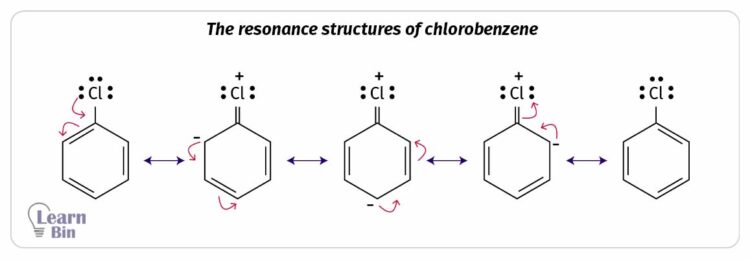
Due to this partial double bond, the bond energy of the C-Cl is higher than the C-Cl bond energy of the alkyl halides. Therefore, it is difficult to break this bond. Also, when a halogen is attached to the benzene ring, it will activate the benzene ring for an electrophilic substitution reaction.
As shown in Figure 01, the Ortho and para positions are negatively charged. Therefore, electrophiles are easily attracted to the benzene ring. So, aryl halides can undergo electrophilic substitution reactions.
Also, if a double bond is formed by the halogen-bonded carbon, such compounds are called vinyl halides. Vinyl halides also have the following resonance structures.
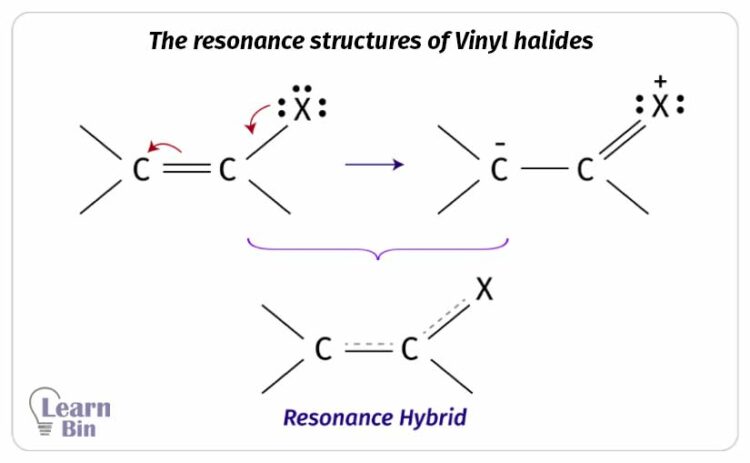
As shown in Figure 02, vinyl halides also form a partial double bond with the carbon atom. Therefore, vinyl halides have much stronger C-X bonds when compared to alkyl halides. That means it is difficult to break this bond in nucleophilic substitution reactions. So, vinyl halides undergo a nucleophilic substitution reaction.
Vinyl halide can undergo an elimination reaction to form alkynes in the presence of a strong base like NaNH2. Also, they show coupling reactions by forming new C-C bonds. Specifically, vinyl chloride is used in the preparation of PVC (Poly Vinyl Chloride) polymers.
Alkyl halides with the same alkyl group and different halides show different reactivity in nucleophilic substitution reactions. When the radius of the halogen gets bigger, the C-X bond length also increases. When a bond length is high, it is easy to break a bond. Thus, the reactivity increases when the halogen is getting bigger.

In nucleophilic substitution reactions, the halogen is removed as a negatively charged ion, leaving behind a positive charge on the carbon atom. It forms primary, secondary, and tertiary carbocations from primary, secondary, and tertiary alkyl halides, respectively.
The reaction occurs through the most stable intermediate carbocation. Therefore, the tertiary alkyl halides have the highest reactivity, while the primary alkyl halides have the lowest.
Primary < Secondary < Tertiary
Since primary and secondary alkyl halides have less reactivity, they will react in a single-step process. The removal of the halogen and the addition of the nucleophile happen at the same time. However, the nucleophilic substitution reaction of the tertiary alkyl halides happens in a two-step process.
First, the halogen is removed, and the intermediate tertiary carbocation is formed. Then the nucleophile attacks the positively charged carbon to form products.
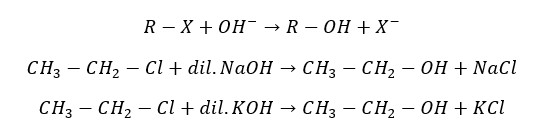
NaOH is a strong base. Therefore, in the medium of water, it will dissociate into OH- ions and Na+ ions. The OH- ions act as nucleophiles and will attract the positively charged carbon to form an alcohol. Instead of NaOH, a strong base, KOH, can also be used here.
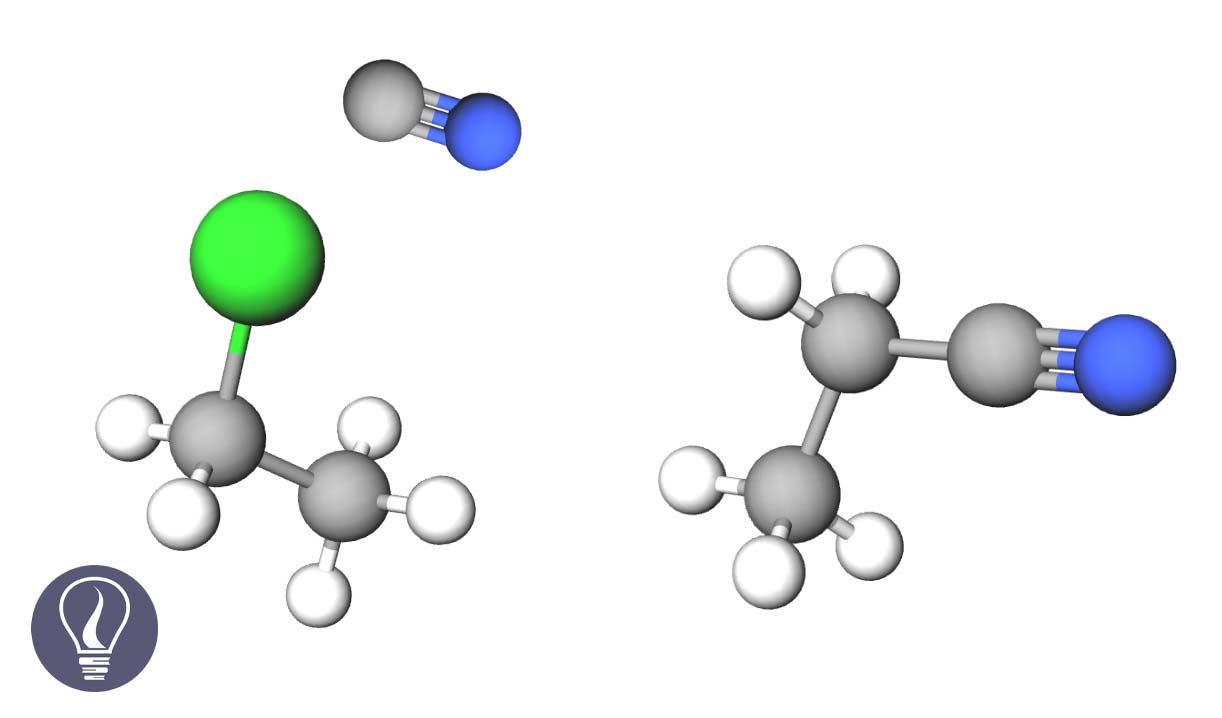
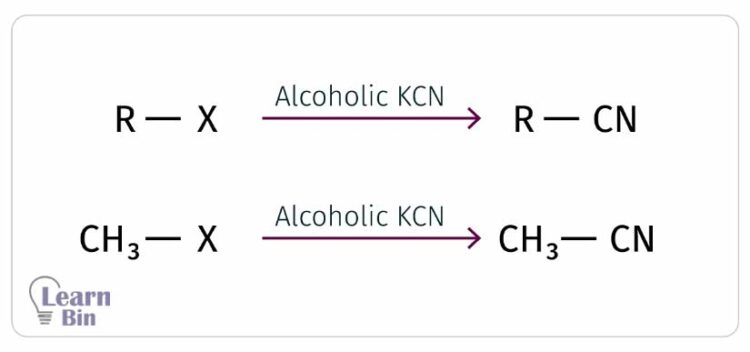
The reaction of alkyl halides with alcoholic KCN results in alkyl nitriles. A CN- ion is substituted for the alkyl halide. When a CN- is attached to the alkyl halide, the number of carbon atoms in the carbon chain increases by 1.
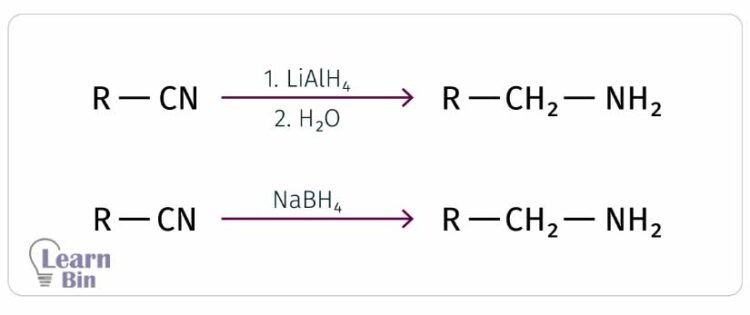
The formed alkyl nitriles can be reduced to primary amines using oxidizing agents like Lithium aluminum hydride (LiAlH4) or Sodium borohydride (NaBH4). When LiAlH4 is used, the alkyl nitriles are first treated with LiAlH4, and then water is added.
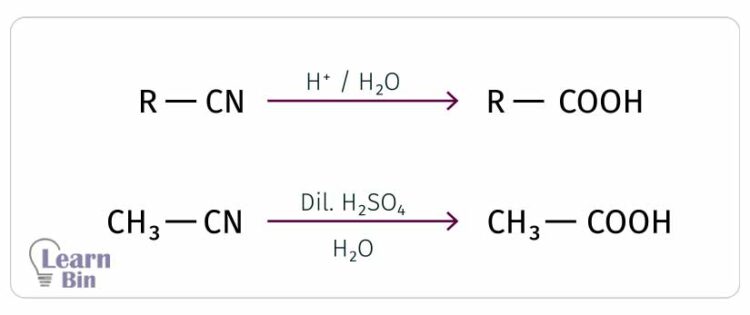
Also, the nitrile group can be converted into a Carboxyl group (-COOH) from a hydrolysis reaction. An alkyl nitrile is treated with water or dilute acid, resulting in a carboxylic acid.
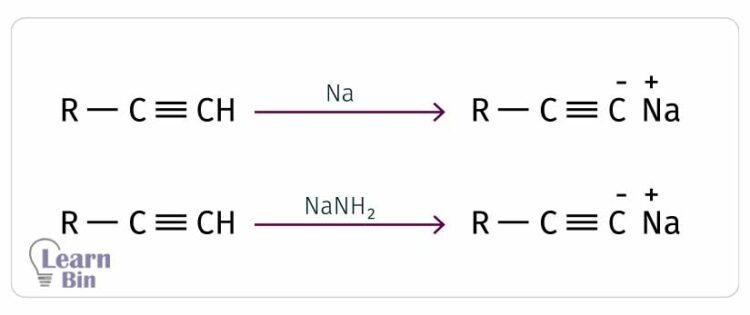
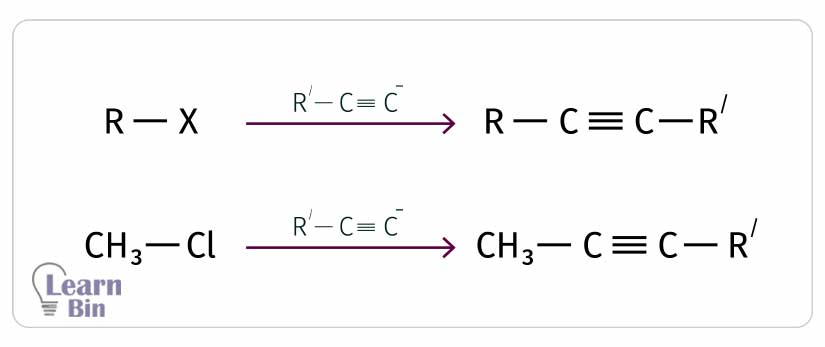
An acetylide ion can be prepared from the reaction of terminal alkynes with highly reactive metals like Na or strong bases like NaNH2. The acetylide ion has a negative charge on the terminal carbon. Therefore, it can act as a nucleophile and attack the positively charged carbon in the alkyl halide to give products.
From this reaction, an alkyne is formed. The number of carbon atoms in the final product would be the sum of the carbon atoms in the initial alkyl halide and the acetylide ion.
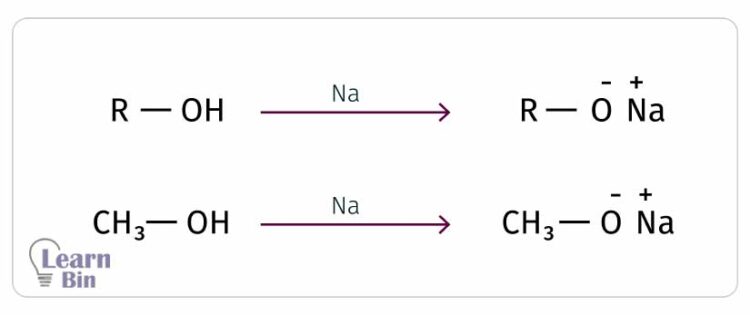
Alkoxide ion(R-O-) can be prepared from the reaction of alcohols with highly reactive metals like sodium (Na). Since the alcohols have acidic properties, they can react with metals and liberate H2 gas. Here, the sodium salt of the alkoxide ion is formed.
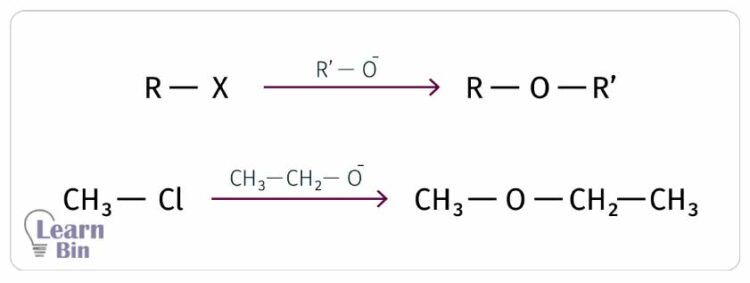
In an alkoxide ion, there is a negatively charged oxygen attached to an alkyl group. The alkoxide ion can act as a nucleophile and attack the positively charged carbon atom in the alkyl halide. From this reaction, it forms an ether.
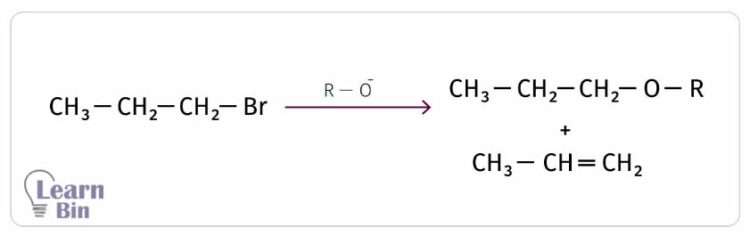
Alkoxide ion is more basic than OH- ion. Usually, alkyl halides undergo an elimination reaction in the presence of a strong base. Therefore, from this reaction, an alkene can result as a byproduct as follows.
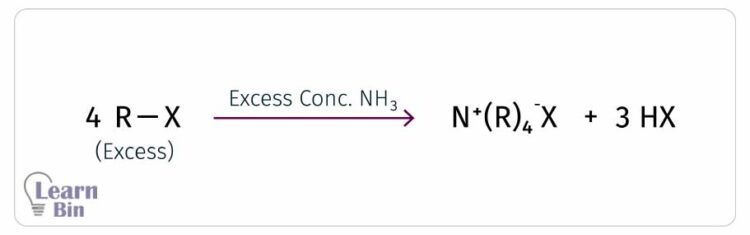
Alkyl halides are heated with excess concentrated ammonia to obtain amines. In ammonia, there is a lone pair of electrons on the nitrogen. Therefore, NH3 can act as a nucleophile.
Depending on the reaction conditions, it can prepare primary, secondary, and tertiary amines. Also, it can prepare the quaternary ammonium salt when excess ammonia is used.
Ammonia and alkyl halides react in a 1:1 ratio to obtain primary amines. A hydrogen in the NH3 is replaced by an alkyl group.

Ammonia and alkyl halide react in a 1:2 ratio to obtain secondary amines. Here, two hydrogen atoms in the NH3 are replaced by two alkyl groups.

Ammonia and alkyl halide react in a 1:3 ratio to obtain tertiary amines. Here, all the hydrogen atoms in the NH3 are replaced by three alkyl groups.

Ammonia and alkyl halide react in a 1:4 ratio to obtain the quaternary ammonium salt. Here, all the hydrogen atoms in the NH3 are replaced by three alkyl groups. Also, the lone pair on the nitrogen is donated to the positively charged carbon atom in another alkyl halide to form a dative bond. It results in a positive charge on the nitrogen.
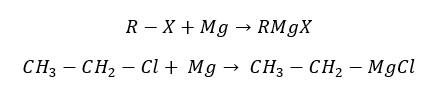
Alkyl halides are reacted with Magnesium (Mg) metal in a dry ether medium. When compared to the carbon that is attached to the halogen, the electronegativity of the Mg is low. So, the carbon is negatively charged. Grignard reagent is highly reactive and sensitive to moisture.

The cover image was created using the molecular editor from Molview.org