More results...

The Grignard reagent is an organometallic compound that has carbon-metal bonds. In the Grignard reagent there is Magnesium as the metal. The Grignard reagent is prepared from the reaction of aryl halides or alkyl halides with metallic magnesium in an anhydrous ether or tetrahydrofuran (THF) medium.
The preparation of the Grignard reagent proceeds through a single-electron transfer mechanism. Magnesium is a highly reactive metal with less electronegativity. On the other hand, the halogen in the alkyl halide is highly electronegative.
Mg (magnesium) has two electrons in its valence shell. Out of these two electrons, Mg donates one electron to the halogen atom, which is highly electronegative. This makes a positive (+1) charge on the Magnesium and a negative charge (-1) on the halogen in the alkyl halide.

Then the R-X bond in the anion undergoes homolytic cleavage, producing R* free radical and the halide ion X-. The formed free radical is highly reactive. The lone electron on the R* free radical and the remaining electron on the Mg will combine to form an organometallic bond of the C-Mg. This results in a positively charged ion where the positive charge is on the Mg atom.
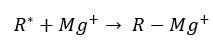
Then this ion reacts with the negatively charged halogen in the medium, giving the final product of the Grignard reagent.

The reaction medium should be in anhydrous conditions. If there is water in the medium, it undergoes a hydrolysis reaction and forms products as follows.

Also, the reaction atmosphere should be inert. If there is Oxygen, the Grignard reagent will readily react with the oxygen and form organic peroxides and alcohols from further hydrolysis.
The C-Mg bond in the Grignard reagent is a polar bond. Carbon is electronegative compared to Mg. Therefore, there is a negative charge on the carbon. This makes Grignard's reagent strongly basic. Therefore, the reaction medium should not include any acidic gases like CO2.
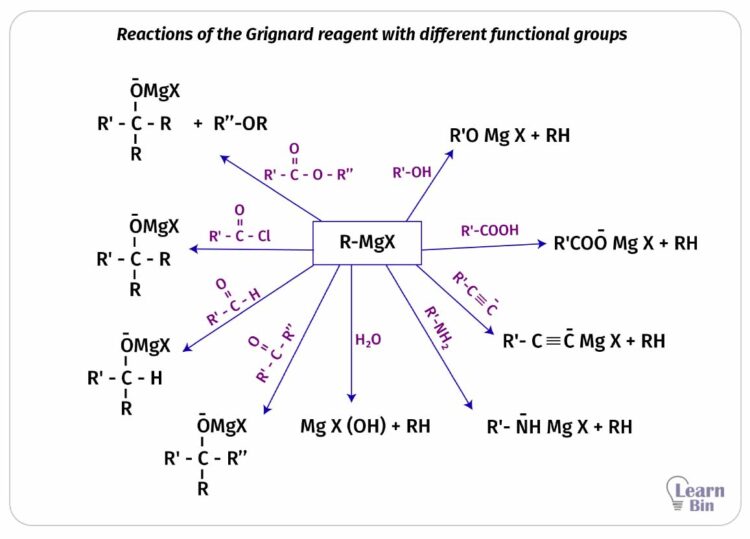
Additionally, functional groups with highly electronegative atoms must not be included in the carbon chain of the alkyl halides. The following functional groups should not be included.
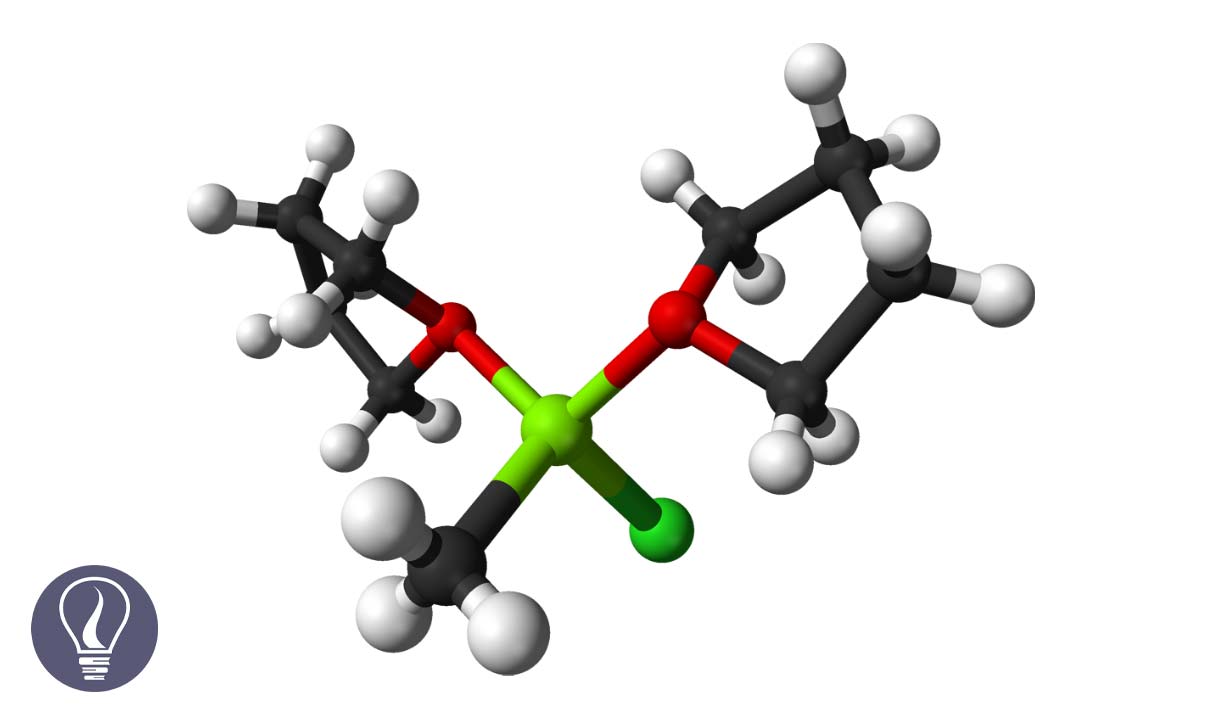
It uses Diethyl ether or THF medium for the synthesis of the Grignard reagent. It stabilizes the highly reactive RMgX species by coordinating with magnesium.

The cover image (Ball-and-stick model of methylmagnesium chloride, CH3MgCl, coordinated by two tetrahydrofuran molecules) was designed using an image by Benjah-bmm27, licensed under Public domain, via Wikimedia Commons