More results...
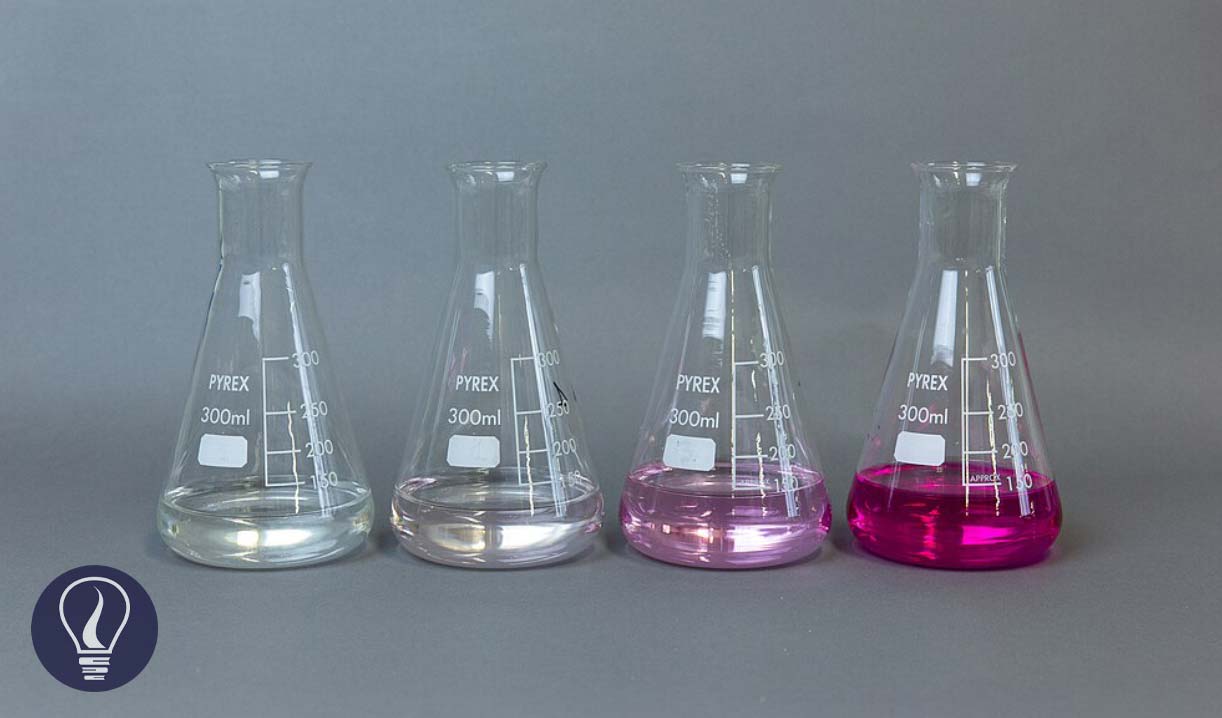

Acid-base indicators are weakly acidic substances that are used to identify whether a solution is acidic or basic. Indicators show different colors in different pH ranges. Acid-base indicators are widely used in analytical chemistry in titrimetric methods.
Acid-base indicators show one color when the pH of the solution is less than a particular value, and they show another distinct color when the pH of the solution is higher than another particular value. As an example, let's take an acid-base indicator that shows one color when the pH of the solution is less than 6.5 and it shows another color when the pH of the solution is higher than 7.5. For this indicator, it shows its acidic color when pH is less than 6.5, and it shows its basic color when pH is higher than 7.5. The difference between those two values is known as the pH range of the indicator.
As mentioned before, an acid-base indicator is a weakly acidic substance. It can dissociate partially in an aqueous medium, giving protons (H+ ions) to the solution as follows,

HIn is the acid-base indicator. When it is in the undissociated form (HIn), it shows its acidic color. When it gets dissociated, it shows its basic color. This phenomenon can be explained using the Le Chatelier principle. In an acidic medium, the H+ ion concentration is high. Therefore, the above equilibrium tends to the backward direction (reverse reaction occurs more) and thus it increases the HIn concentration in the medium. Therefore, the solution shows the specific color for an acidic medium.
Also, when this indicator is added to a basic solution, the OH- ions in the medium react with the H+ ions given by the dissociation of the indicator. Thus, the H+ ion concentration is decreasing. According to the Le Chatelier principle, the above equilibrium tends to right-hand direction in order to increase the H+ ions in the solution. Hence, the In- ion concentration of the medium increases. So, the solution shows the specific color for the basic medium.
Since an acid-base indicator is a weak acid, it will dissociate partially in an aqueous solution. The dissociation constant for the indicator can be written in terms of the concentrations of each component.

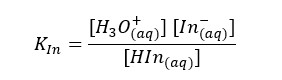
As the concentration of water in an aqueous solution is a constant, the concentration of water has been neglected here. Kin is known as the dissociation constant of the indicator. Using the KIn value, the pH of the indicator can be found.
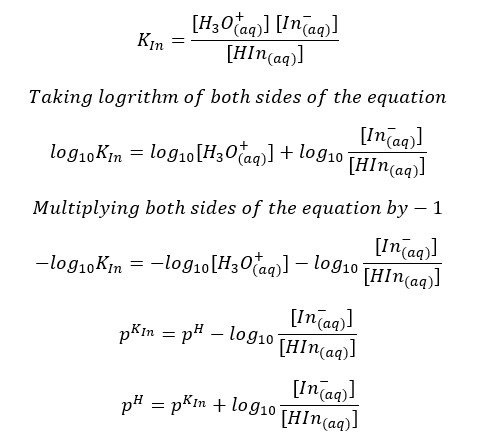
Using the above equation, the pH of the indicator can be calculated. Where, [In-] is the dissociated indicator concentration and [HIn] is the undissociated indicator concentration. At a given temperature, pKin is a constant. Therefore, the pH of the indicator depends on the ratio between the dissociated and the undissociated indicator concentration.
Usually, the pH range of an indicator lies between pKIn + 1 and pKIn - 1.
Table 01 shows some of the acid-base indicators and their pH range, pKIn, and the acidic color and the basic color.
| Indicator | pH range | Acidic color | Basic color | pKin |
| Thymol blue | 1.2 – 2.8 | Red | Yellow | 1.7 |
| Bromophenol blue | 3.0 – 4.6 | Yellow | Purple | 4.1 |
| Methyl orange | 3.2 – 4.4 | Orange | Yellow | 3.7 |
| Methyl red | 4.2 – 6.3 | Red | Yellow | 5.0 |
| Chlorophenol red | 5.2 – 6.8 | Yellow | Red | 6.0 |
| Bromothymol blue | 6.0 – 7.6 | Yellow | Blue | 7.1 |
| Cresol red | 7.2 – 8.8 | Yellow | Red | 8.2 |
| phenolphthalein | 8.3 – 10.0 | Colorless | Reddish pink | 9.6 |

Harris, D. C.; Lucy, C. A. Quantitative Chemical Analysis, 9th ed.; W. H. Freeman & Company: New York, 2016.
The cover image was created using an image by Lisa Simpson 23, licensed under CC BY-SA 4.0, via Wikimedia Commons