More results...

Friedel-Crafts reactions, including Friedel-Crafts alkylation and Friedel-Crafts acylation, are a set of electrophilic aromatic substitution reactions used to substitute an alkyl or acyl group into an aromatic compound. This reaction series was introduced in 1877 by French chemist Charles Friedel and American chemist James Mason Crafts.
These Friedel-Crafts reactions are catalyzed by strong Lewis acids such as AlCl3. There are two main types of Friedel-Craft reactions.
These reactions are widely used in the synthesis of dyes, fragrances, and pharmaceuticals, making them essential in organic chemistry and industrial applications.
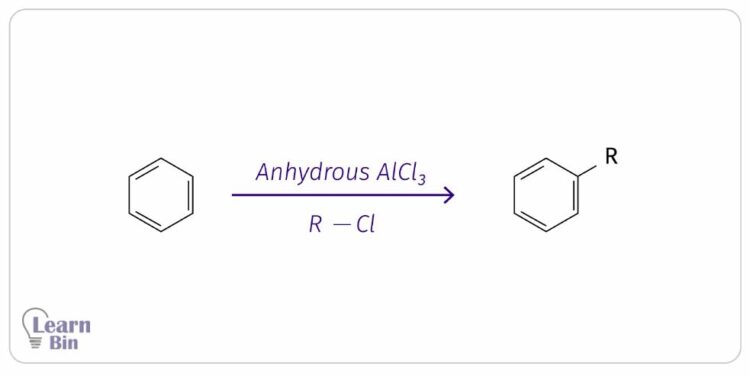
Friedel-Crafts alkylation is an electrophilic aromatic substitution reaction that substitutes an alkyl group into a benzene ring. It uses alkyl halide as the alkyl group carrier and anhydrous AlCl3 as the catalyst.
When benzene is treated with an alkyl halide in the presence of an anhydrous AlCl3 catalyst, it results in alkylbenzene. (methylbenzene, ethylbenzene , etc.). The -R group comes from the alkyl halide and acts as the electrophile here.
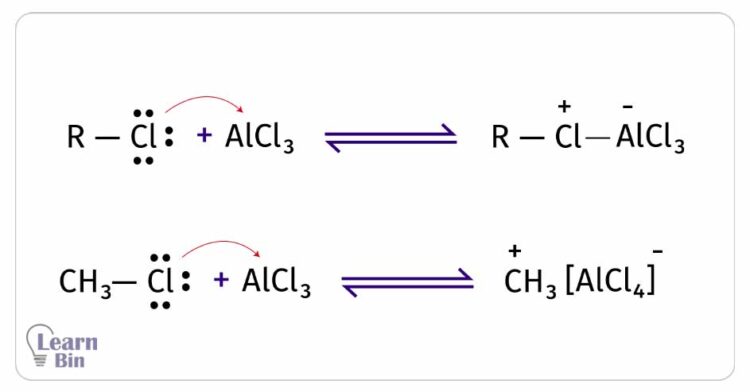
AlCl3 is a Lewis acid. The valence shell of the Al in AlCl3 is deficient in electrons. It has only 6 electrons in the valence shell, and it needs two more electrons to make 8 electrons. On the other hand, the halogen in the alkyl halide has three lone pair electrons.
One lone pair is donated to the empty orbital in the aluminum atom and forms a dative bond. In this process, the halogen in the alkyl halide gets a positive charge, and Al gets a negative charge. As an example, if CH3−Cl (methyl chloride) is used as the alkyl halide, it forms a complex as follows.
When there is a positive charge on the Cl, the electronegativity of Cl increases. Also, Cl originally is a highly electronegative atom. Therefore, Cl takes electrons from the C-Cl bond. At the same time, Carbon gets a positive charge, and the pi electrons in the benzene attack this carbon.
For primary alkyl halides like methyl chloride, it does not form a separate intermediate carbocation, but rather a highly activated complex. Because a primary carbocation is very unstable, the pi electrons attack the carbon at the same moment when the halogen takes electrons from the C-Cl bond (a concerted mechanism).
(Note: For secondary and tertiary alkyl halides, a discrete, more stable carbocation is formed as the electrophile before attack. Furthermore, primary carbocations that can rearrange will do so immediately via a hydride or alkyl shift, yielding rearranged products.)
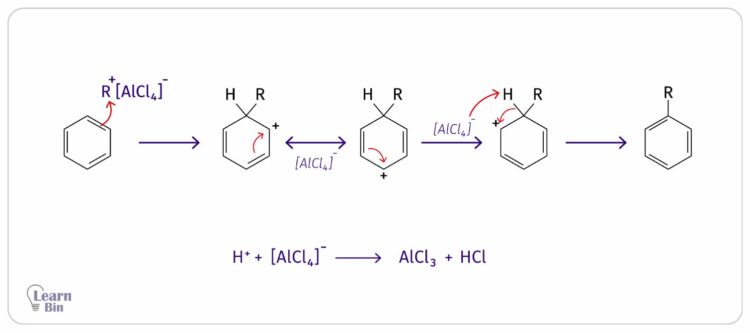
Using the Kekulé structure, the reaction mechanism can be explained. According to the Kekulé structure of benzene, there are three pi bonds in the benzene ring. Out of these three bonds, the pi electrons from one bond attack the positively charged carbon.
So, the pi bond is broken down, and one carbon atom in the pi bond attaches to the alkyl group (-CH3), then the other carbon gets a positive charge. Thus, the Wheland intermediate (or arenium ion or σ-complex) is formed. The positive charge on the Wheland intermediate delocalizes in the benzene ring. In the reaction mechanism, it can be observed that there is a positive charge on the ortho and para carbon atoms in the benzene ring.
Finally, the [AlCl4]− ion in the medium attacks the hydrogen bonded to the carbon to which the alkyl group is attached. This hydrogen gives electrons from the C-H bond to the benzene ring and is eliminated as a H+ ion. This H+ ion and the [AlCl4]− regenerate AlCl3 and form the respective hydrogen halide. In this example, it would be HCl.
The three resonance structures of the Wheland Intermediate (or arenium ion or σ-complex) can be represented in one resonance hybrid as follows.
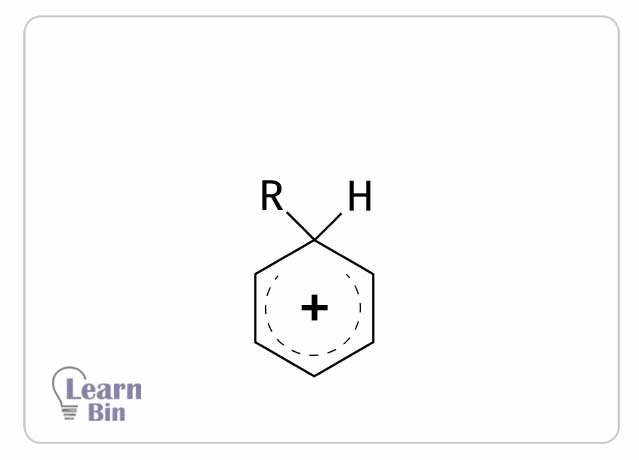

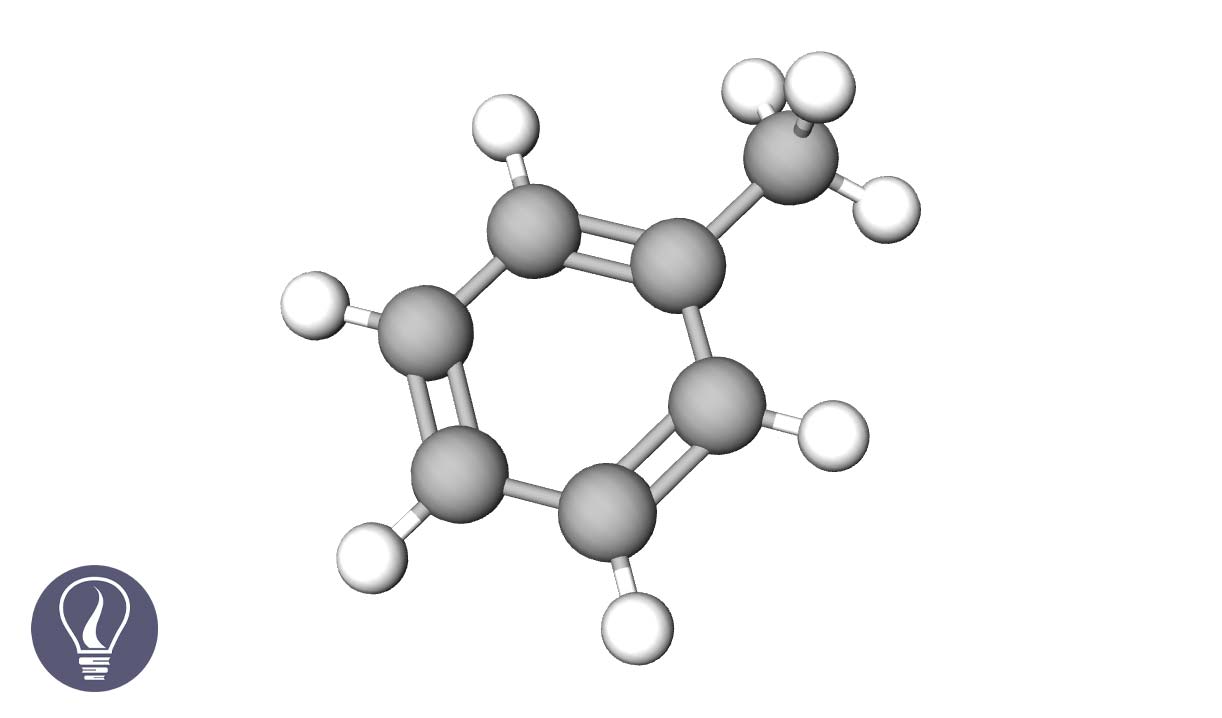
The cover image was created using the molecular editor from Molview.org