More results...
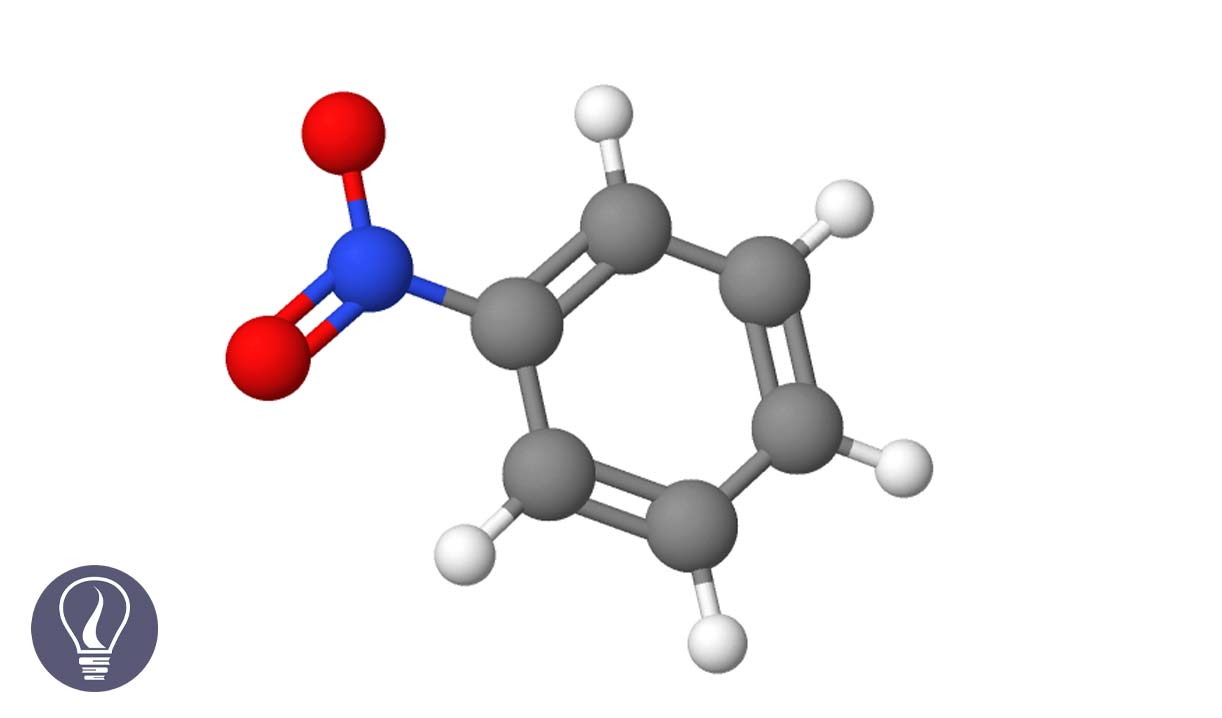

The nitration of benzene is a fundamental organic reaction that introduces a nitro group (-NO2) into the benzene ring. The nitronium ion (NO2+) acts as an electrophile and it is substituted to the benzene ring through an electrophilic aromatic substitution (EAS) mechanism.
Since benzene is a less reactive compound, it requires a catalyst and high temperature to occur in this reaction. So, this reaction is carried out in a medium of concentrated sulfuric acid and concentrated nitric acid.
Nitrobenzene is a pale yellow toxic with the odor of bitter almonds. Nitrobenzene is primarily used as a raw material in the industry for the production of aniline, dyes, pigments, pharmaceuticals, etc.
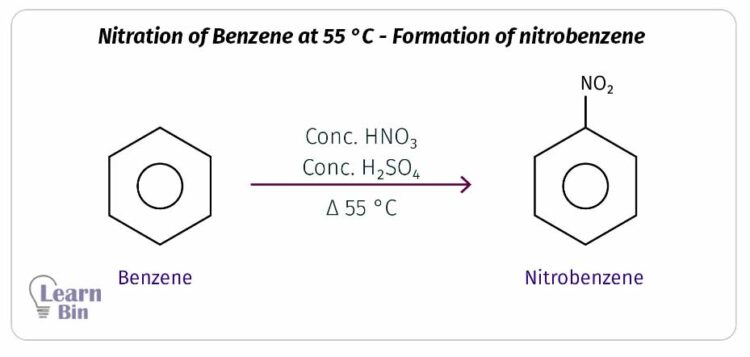
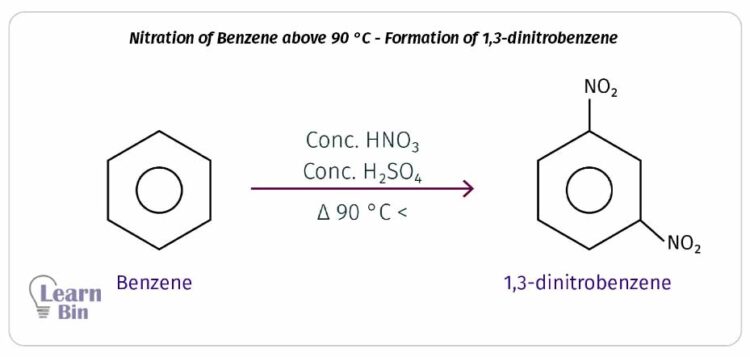
When benzene is heated up to 55 °C in the presence of concentrated sulfuric acid (H2SO4) and concentrated nitric acid (HNO3), a -NO2 group is substituted onto the benzene and yields nitrobenzene as the product. If the temperature is higher than 90 °C, two NO2 groups are substituted and form 1,3-dinitrobenzene.
When compared to the acidity of HNO3, H2SO4 is more acidic. That means H2SO4 can easily dissociate and give H+ ions to the medium. Since this is a concentrated situation, sulfuric acid will dissociate and give only one H+ ion to the medium. The nitric acid will not dissociate in these conditions.

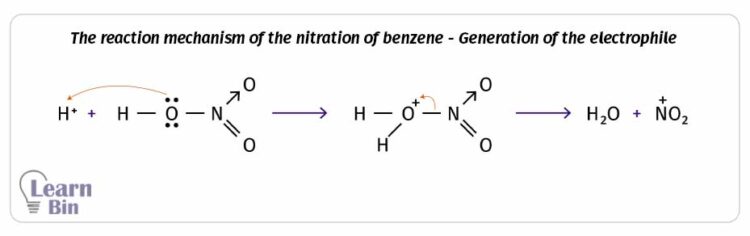
In nitric acid, HNO3, there are three types of N-O bonds. There is an N=O double bond, an N->O dative bond, and an N-O-H sigma bond. The oxygen atom that has bonded to both nitrogen and hydrogen has two lone pairs of electrons.
These electrons will attack the H+ ions in the medium and form an O-H dative bond. This results in a positive charge on the oxygen atom. Oxygen is a highly electronegative atom. So, it is difficult for oxygen to bear a positive charge on it. Therefore, it takes electrons from the N-O bond and eliminates them as an H2O (water) molecule.
Since the electrons have been taken from the N-O bond, it forms a positive charge on the Nitrogen atom. Thus, the NO2+ electrophile is formed. In this process, a water molecule is eliminated from the nitric acid. That means the nitric acid has been dehydrated by sulfuric acid.
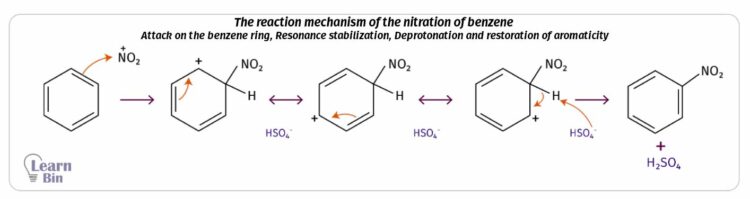
The generated NO2+ ion (the electrophile) is attacked by the pi electrons of the benzene when it comes closer to the benzene. Then, it forms an intermediate "Arenium ion (σ-complex)". The positive charge is delocalized in the benzene ring, and then it recreates the pi electron cloud by removing a hydrogen atom as an H+ ion.
This H+ ion and the HSO4- ion in the medium regenerate the sulfuric acid. Sulfuric acid has been used in the reaction and regenerated at the end. Therefore, it acts as a homogeneous catalyst here.

The cover image was created using the molecular editor from Molview.org