More results...
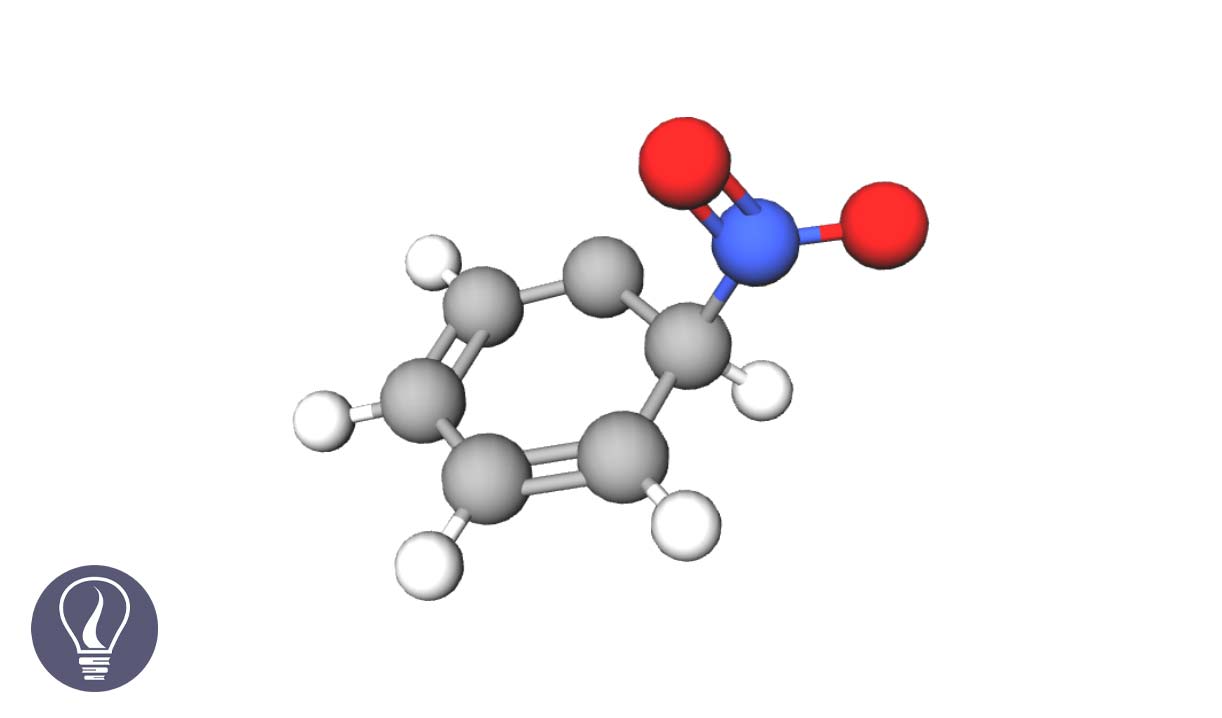

Benzene is the simplest aromatic hydrocarbon with six carbons and six hydrogen atoms arranged in a perfectly symmetrical ring. Benzene plays a crucial role in organic chemistry due to its unique reactivity and stability. In this article, we will explore the reactions of benzene, highlighting the processes that set it apart from other unsaturated hydrocarbons.
Unsaturated aliphatic hydrocarbons, which are alkenes and alkynes, undergo electrophilic addition reactions. Even though benzene is an unsaturated compound, it does not undergo electrophilic addition reactions like other unsaturated compounds.
Instead, the most characteristic reaction of benzene is electrophilic aromatic substitution (EAS), which preserves its aromaticity. Additionally, under specific conditions, benzene can participate in oxidation and reduction reactions.
Benzene is a less reactive compound when compared to other unsaturated compounds like alkenes and alkynes. This is because benzene is relatively stable due to its aromaticity. Due to this stability, benzene does not readily undergo typical alkene reactions like hydrogenation. It needs catalysts and extreme conditions of benzene to react.
The stability of benzene depends on the delocalized π-electron cloud in the benzene ring. If this electron cloud collapses somehow, the stability of the benzene will also collapse. Therefore, in most reactions of benzene, it preserves its pi electron cloud.
As an example, both alkenes and benzene attract electrophiles due to their high electron density caused by the pi electrons. When alkenes react with electrophiles, the pi bond is broken down and electrophiles are added to the carbon. Here, the hybridization of the carbon changes from sp2 to sp3.

But when benzene attracts electrophiles, the electrons from the pi bonds in the benzene ring are not used to form new bonds and give the final product. Simply, electrophiles are substituted to the benzene ring, without disrupting the pi electron cloud (the π electrons temporarily interact with the electrophile to form a σ-complex intermediate; however, the final product restores the aromatic π-electron cloud). When benzene is reacting, the hybridization of the carbon atoms does not change.
Since the electrophile is substituted on the benzene, the ideal reaction type of the benzene is an “Electrophilic aromatic substitution (EAS)”
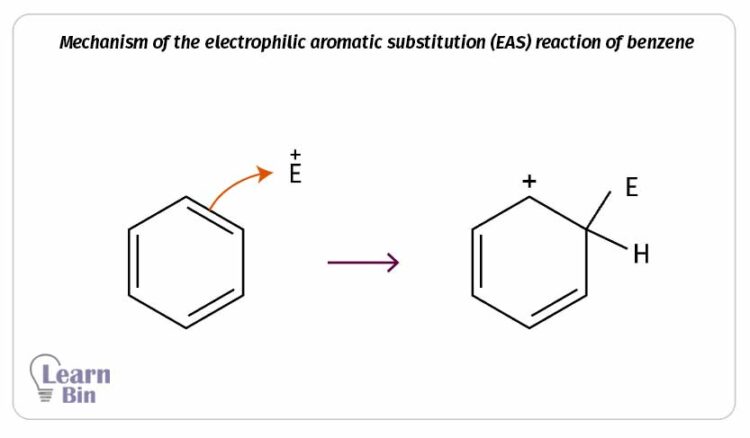
Benzene has a pi electron cloud with six electrons. Due to this electron cloud, the electron density around the benzene ring is high. So, it can attract positively charged ions or groups (electrophiles). When an electrophile comes close to the benzene ring, the pi electron will attack the electrophile and form an intermediate carbocation.
It uses the Kekulé structure to describe the reaction mechanism. According to the Kekulé structure, there are three double bonds in the benzene ring. The electrons in one double bond of the benzene attack the electrophile.
Then, one carbon in the double bond forms a bond with the electrophile using the pi electrons. The other carbon atom gets the positive charge since the bond has been broken. Then, an intermediate ion is formed. This resulting intermediate is called a resonance-stabilized arenium ion (σ-complex).
The positive charge in the arenium ion is delocalized over three carbon atoms of the benzene ring. This delocalization, shown by its resonance structures, makes the arenium ion more stable than a typical alkyl carbocation, even though the aromaticity of the ring is temporarily lost.
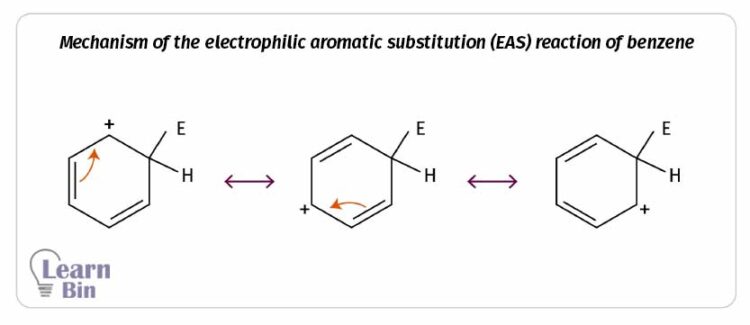
As shown in Figure 02, the positive charge is conjugated between the remaining two pi bonds. By that, the positive charge is delocalized. It gets quite a bit of stability from this delocalization. But it is more stable when there is a pi-electron cloud.
So, the benzene ring takes electrons from the C-H bond and forms the aromatic ring again. Here, the hydrogen is removed as an H+ ion. But it needs a nucleophile to attack the hydrogen to remove it as an H+ ion.
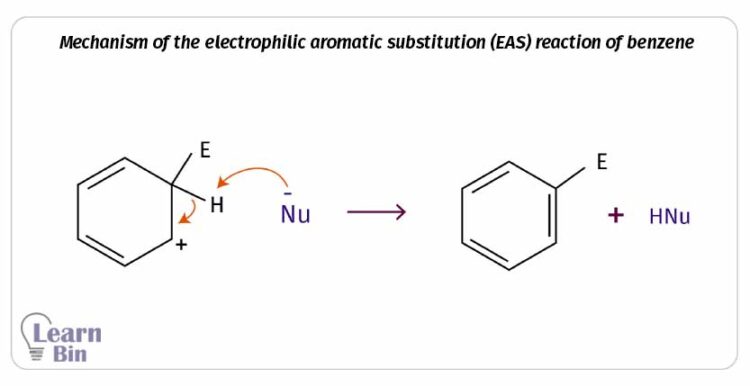
When the overall process is considered, it has substituted an electrophile instead of a hydrogen. Therefore, the ideal reaction of benzene is the electrophilic aromatic substitution (EAS) reaction.

The cover image was created using the molecular editor from Molview.org