More results...
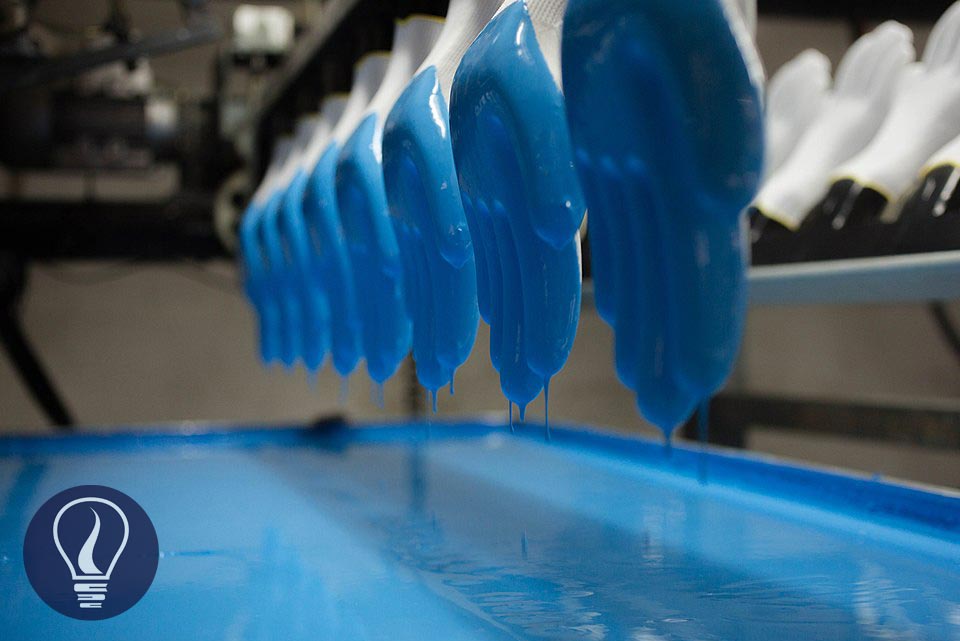

In the straight dipping process, sometimes, several dips are carried out to get a thicker film of latex on the final product. Subsequent dips in the straight dipping process refer to these additional dips carried out after the initial one. Each dip in the subsequent dipping process adds another layer, resulting in a thick and multilayer product.
This technique is commonly used in rubber glove manufacturing, ceramic shell molding, and biomedical coatings. The number of dips and drying conditions impact the final product's thickness, strength, and properties. Proper control during this process is essential to avoid defects in products like uneven coatings or trapped air bubbles.
Depending on the product, sometimes two or three additional dips are carried out. The process of a subsequent dip is generally the same as the first dip. But in a subsequent dip, the latex is coated on a rubber surface, not on the former material. On the rubber surface, there is usually a lower surface energy than the former material. Therefore, some deficiencies can occur during the wetting process.
In a subsequent dipping process, the first dip is slightly heavier than subsequent dips. In a two-dip process, 55% of the latex in the finished product comes from the first dip. In a three-dip process, 40% of the latex comes from the first dip. Too heavy pick up in the first dip leads to drying problems, cracking, and air entrainment.
One way to reduce the first pickup is by decreasing the Total Solid Content (TSC) in the first dipping tank. Then the product weight is compensated in subsequent dips. This means there are different compositions in different dipping tanks. So, it will increase the manufacturing complexity.
Also, the temperature of the former when it enters the next dip is very important. If the former is too hot, it induces an instability and gives rise to coagulum. Also, hot formers can accelerate the skin formation on the latex surface. Any temperature variation that is created in the latex will affect the viscosity of the latex. When the viscosity changes, it affects the pick up and the sedimentation of any solid ingredients.
In general, the temperature is preferably below 40 °C. To obtain this temperature, a cooling stage is added at the exit of the intermediate drying.
The degree of drying of the latex in subsequent dips is also very important. If the latex film of the previous dip is still damp when it enters the next dip, it causes uneven drying. And it results in film cracking. Also, a damp film is much weaker than a dry film, so it can be easily damaged. On the other hand, if the film is too dry, the subsequent layers may not bond with the previous layer well.
Therefore, the drying conditions should be perfectly adjusted. If the film is still wet, it has a cloudy appearance. When it dries up, it becomes transparent. So, the subsequent dip can be carried out when the latex film has just lost its cloudy appearance.

Hill, D. M. Latex dipping: Science and Technology; Walter de Gruyter GmbH & Co KG, 2019.
The cover image was designed using an image by Marketingdepascale, licensed under CC BY-SA 4.0, via Wikimedia Commons