More results...
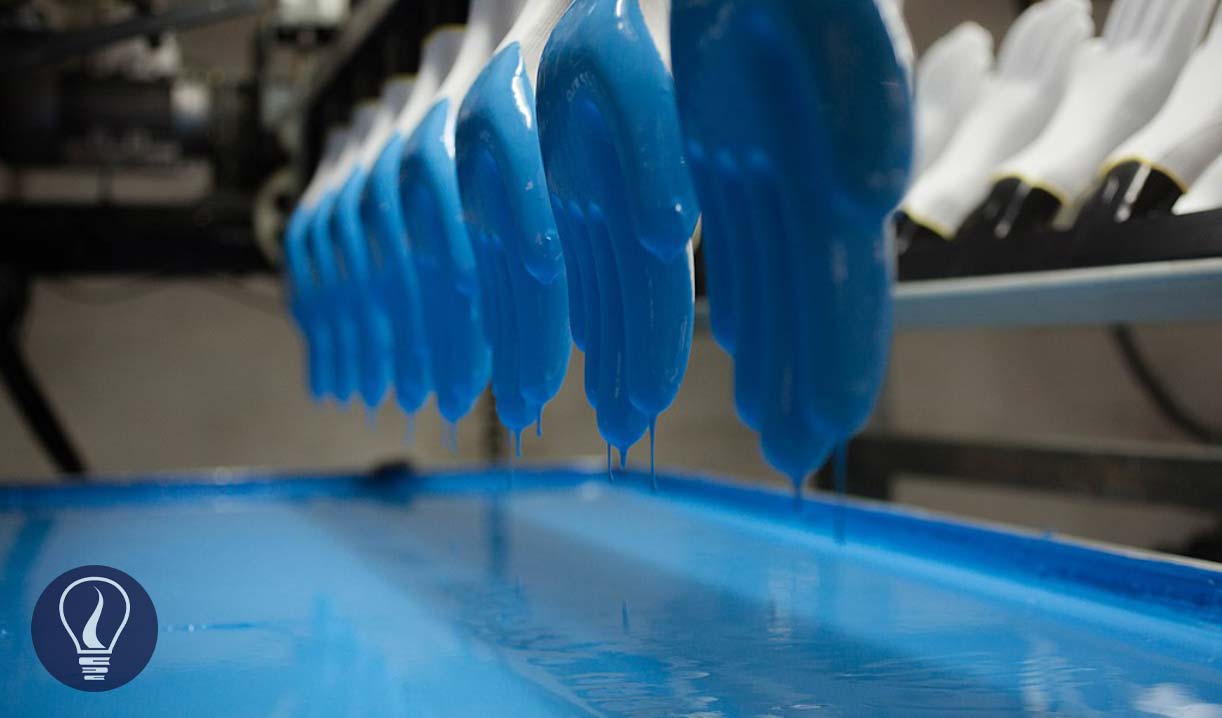

Latex dipping techniques are widely used in the industry in order to manufacture thin films of latex.
Simply, the dipping process is immersing a shaped mold (former) in a compounded latex and forming a thin layer of latex. Then the latex layer is dried and removed from the mold. After the latex film is removed, it needs further treatment before use.
Industrially, synthetic lattices as well as natural lattices are used for the dipping process. Lattices such as natural rubber (NR), polychloroprene (CR), acrylonitrile butadiene rubber (NBR), and synthetic polyisoprene are widely used for the dipping process.
Copolymers such as styrene-butadiene (SBR), polyurethane, polyvinyl acetate (PVA), and various acrylic Copolymers can also be dipped. But still, there are a few industrial applications of dipped copolymer products.
According to the application method of the mold to the latex compound, there are several types of latex dipping techniques. Those techniques are,
Out of these techniques, straight dipping and coagulant dipping techniques are widely used in the latex industry.
The straight dipping process is simply that the former is immersed in the compounded latex, forming a thin layer of the latex. Then the former is slowly withdrawn from the latex. Sometimes there can be more latex dips for a single product. The straight dipping process can be described in several major steps.
In the coagulant dipping process, a latex film is formed on the former due to the coagulation of the latex. First, the former is coated with a coagulant. When the former is immersed in latex, the latex will react with the coagulant. Therefore, the electrostatic stability of the latex will collapse if a layer of latex is formed on the former. There are some steps in the coagulant dipping process.
Most of the latex formulations will be unstable when the temperature increases. This heat-sensitive property is used in heat-sensitized dipping. Generally, in this method, a heated former is immersed in the latex. Due to the heat of the former, the electrostatic stability of the latex will collapse. As a result of this, a layer of latex is formed on the former.
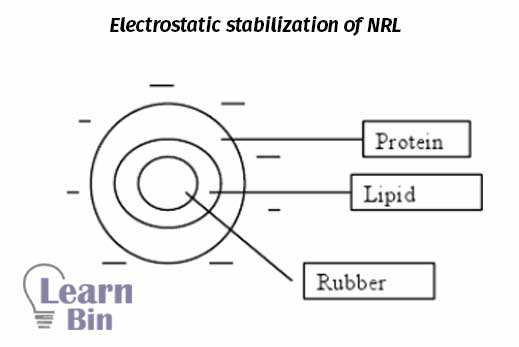
Latex has electrostatic stability due to the negative charge around the latex particles. Since they have a negative charge, they can be attracted by an anode. This is the basic concept that is used in electrodeposition.
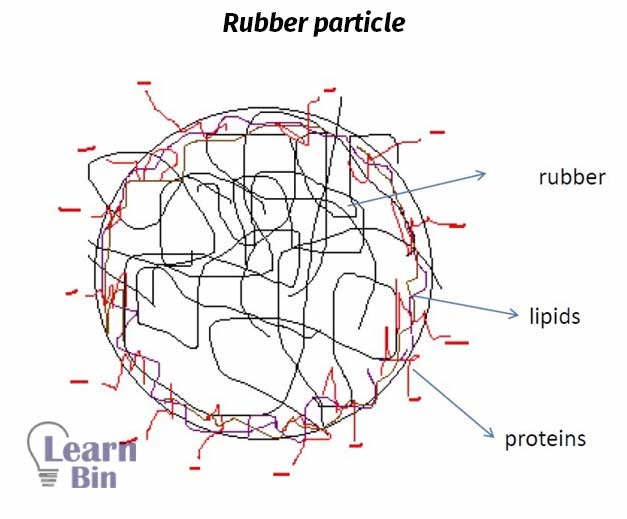
An anode is used as a "former". Then the latex particles will be gathered around the former, and the latex particles will be neutralized. Then the latex will be coagulated since the electrostatic stability has collapsed. Thus, a latex film is obtained.
Spray coating is an alternative method for latex dipping. A correctly formulated rubber lattice is sprayed on a mould. Usually, the spray coating method is used in small-scale production. The spraying process is carried out by using low-pressure, high-volume spray guns. These can be operated either by hand or automated. If it is operated by hand, it needs higher skills to obtain a high-quality product.

Hill, D. M. Latex dipping: Science and Technology; Walter de Gruyter GmbH & Co KG, 2019.
The cover image was designed using an image by Marketingdepascale, licensed under CC BY-SA 4.0, via Wikimedia Commons